
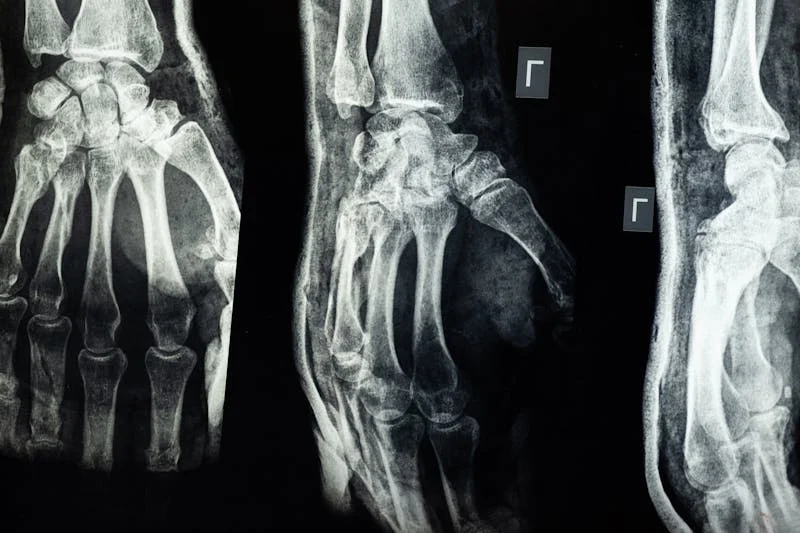
Broken bones are painful, disruptive, and often require a long recovery. After a car accident in Chicago, a fracture claim has to show more than the diagnosis on an X-ray. It needs to show the real-life impact: lost work time, medical costs that stack up over months, and limitations that sometimes linger well after the bone itself has healed. This guide explains how fracture claims actually get built and valued, and where insurers push back.
Common Fractures in Car Accidents
- Rib fractures from seatbelt loading and airbag deployment, which are common even in moderate-speed crashes
- Wrist and forearm fractures from bracing against the steering wheel or dashboard on instinct
- Leg, ankle, and foot fractures from pedal or dashboard impact, particularly common for the front-seat passenger with no controls to brace against
- Collarbone fractures in side-impact collisions, where the shoulder belt takes the brunt of the force
- Pelvic fractures in high-speed or offset-impact crashes, among the more serious fracture types because of the blood vessels running through the pelvic region
- Facial and skull fractures from airbag or window contact, which sometimes come with a concurrent concussion that needs its own evaluation
How Fractures Are Diagnosed
Most fractures are confirmed with an X-ray, which is fast and effective for showing a clean break in bone. A CT scan often follows when a fracture is complex, involves multiple bone fragments, or sits near a joint where surgical planning needs more detail than a plain X-ray provides. An MRI comes into play less for the bone itself and more when a doctor suspects accompanying soft-tissue damage, a torn ligament near the fracture site, or a stress fracture that hasn’t fully separated and might not show clearly on X-ray. Keeping copies of every imaging report, not just the radiologist’s one-line summary but the full report, matters because insurers and their own reviewing physicians will scrutinize the specific language used to describe the break.
Treatment and Recovery Timeline
Recovery time depends heavily on which bone broke, how severely, and whether surgery was required. A simple, non-displaced fracture treated with a cast might heal in six to eight weeks. A displaced fracture requiring open reduction and internal fixation, the surgical placement of plates, screws, or pins to hold the bone in proper alignment, involves a longer timeline: surgery itself, weeks of restricted weight-bearing or movement, and then a course of physical therapy to rebuild strength and range of motion once the bone has healed enough to tolerate it. Pelvic and hip fractures in particular often require an extended period of limited mobility and, for some patients, temporary home care assistance for basic daily tasks. Hardware placed during surgery sometimes stays in permanently and sometimes requires a second surgery to remove later, which is itself a future medical cost that belongs in the claim.
How Fractures Affect Your Claim Value
Fracture claims often carry higher value than soft-tissue injury claims for a few concrete reasons. The imaging evidence is objective: a broken bone shows up clearly on a scan in a way that’s hard for an insurer to dispute, unlike a soft-tissue strain that relies more heavily on subjective pain reporting. Recovery periods tend to be longer and more clearly documented through a series of orthopedic follow-up visits. Fractures also carry a real risk of permanent impairment, reduced grip strength after a wrist fracture, a persistent limp after a leg fracture, chronic pain at a healed break site, that a treating physician can speak to directly with clinical language a jury or adjuster takes seriously.
Damages You Can Recover
- Medical bills, from the emergency room through orthopedic follow-up and any hardware-removal surgery down the line
- Lost wages during recovery, and reduced earning capacity if the fracture permanently limits physically demanding work
- Out-of-pocket expenses, including medical equipment, home care assistance, and transportation to appointments
- Pain, suffering, and loss of normal life, covering the disruption to routine activities during a cast or non-weight-bearing period
- Future treatment and rehabilitation costs, including a realistic accounting of hardware-removal risk or delayed-healing complications
Insurance Tactics in Fracture Claims
A few recurring insurer arguments show up in nearly every fracture claim. Downplaying the severity of the impact is common, pointing to modest-looking vehicle damage as though it proves the fracture couldn’t have happened the way described, an argument that ignores how much force a body can absorb even in a crash that leaves relatively little visible damage to the vehicle itself. Claiming the fracture, or the underlying bone weakness that allowed it, was pre-existing is another frequent move, particularly for older claimants where an insurer might point to age-related bone density loss. Arguing that treatment was excessive, questioning why physical therapy continued for months after a cast came off, ignores that regaining strength and range of motion after prolonged immobilization is itself a real, medically necessary part of recovery. And pressuring an early settlement before the fracture has fully healed, before anyone actually knows whether hardware will need to come out or whether full function will return, is one of the more damaging tactics, since accepting a settlement locks in a number before the true extent of the injury is even known.
Comparative Fault and Fracture Claim Value
Illinois follows a modified comparative negligence rule under 735 ILCS 5/2-1116, which reduces your recovery by your own percentage of fault and bars recovery entirely if you’re found more than 50% responsible for the crash. This matters a lot for a fracture claim, since the total value tends to be higher than a typical soft-tissue case, so a shift of even a few fault percentage points has real financial weight. As a hypothetical: a pedestrian struck at a Chicago crosswalk suffers a pelvic fracture requiring surgery, with total damages valued at $350,000. If a jury or insurer determines the pedestrian was 15% at fault, perhaps for stepping off the curb slightly before the signal changed, the recoverable amount drops to $297,500. Insurers routinely look for any basis, however small, to shift some percentage of fault onto the injured person specifically because of how much a high-value fracture claim moves with each percentage point.
Filing Deadlines and Government-Entity Claims
Most fracture claims arising from a car accident fall under Illinois’ standard two-year statute of limitations for personal injury, 735 ILCS 5/13-202. If a CTA bus, a city vehicle, or a road defect on a government-maintained street contributed to the crash, though, a much shorter one-year filing deadline applies under the Local Governmental and Governmental Employees Tort Immunity Act, 745 ILCS 10/8-101. Missing that deadline can bar the claim entirely, so any crash involving a government vehicle or government property needs that deadline flagged immediately rather than left until treatment wraps up.
Multiple Fractures and Polytrauma Claims
A higher-speed or T-bone-style crash sometimes produces more than one fracture at once, a wrist fracture from bracing plus rib fractures from the seatbelt, for example. Polytrauma cases like this require coordinated documentation across multiple treating specialists, an orthopedic surgeon for the extremity fracture, possibly a separate specialist for the rib injuries if there’s an associated lung complication like a pneumothorax. Insurers sometimes try to evaluate each fracture in isolation, as though they were separate, unrelated minor injuries, rather than accounting for how multiple simultaneous fractures compound recovery time and functional limitation. A claim involving more than one fracture should present the injuries together, showing how limited mobility in one limb complicates recovery from an injury elsewhere in the body.
A Worked Example
Consider a hypothetical: a side-impact crash at a Chicago intersection fractures a driver’s collarbone and two ribs. Surgery isn’t required, but the collarbone takes eight weeks in a sling followed by three months of physical therapy to rebuild shoulder strength, and the rib fractures make sleeping and even coughing painful for the first several weeks. Medical bills total $22,000. The driver misses six weeks of work entirely and returns to modified duty for another month, adding up to roughly $9,000 in lost wages. Add pain and suffering reflecting the extended, genuinely disruptive recovery, and total damages might be valued in the neighborhood of $95,000 to $130,000, depending on how persuasively the functional-limitation evidence, the sleep disruption, the missed family obligations, the modified-duty period, is documented. This range is illustrative only, not a promise about any specific case, since actual settlement value depends entirely on the individual facts, the insurer involved, and the strength of the supporting records.
Fractures in Children and Older Adults
Age changes the medical and legal picture in a fracture claim. A fracture through a child’s growth plate, the area of developing cartilage near the end of a long bone, carries a distinct risk: if it heals improperly, it can affect how that bone grows over the following years, sometimes not becoming apparent until well after the initial injury looked fully resolved. That long-tail risk is part of why a pediatric fracture claim sometimes needs to account for monitoring and potential future treatment extending years beyond the crash itself. Older adults present a different concern: reduced bone density means a fracture can result from a lower-force impact than would break a younger adult’s bone, and insurers sometimes seize on that same reduced density to argue the fracture was inevitable regardless of the crash. That argument doesn’t hold up well against Illinois’ general rule that a defendant takes a plaintiff as they find them, meaning an insurer generally can’t escape liability just because a claimant’s bones were more fragile than average going into the crash, though the exact application depends on the specific facts and medical record in each case.
Chicago-Specific Considerations
Chicago’s stop-and-go expressway traffic and frequent side-impact collisions at busy intersections produce a steady share of rib and upper-body fractures specifically. Winter conditions add another layer: icy roads increase both the frequency of higher-force crashes and the number of pedestrian fractures from slip-and-fall-adjacent vehicle strikes near crosswalks. Documenting the actual crash severity, through the police report’s damage assessment, photographs, or an event data recorder download, helps counter an insurer’s attempt to argue the impact was too minor to cause the fracture described.
Evidence That Protects a Fracture Claim
Because insurers so often try to characterize a fracture-causing crash as lower-force than it actually was, evidence documenting the collision itself matters as much as the medical records that follow. A vehicle’s event data recorder can capture pre-impact speed and braking, useful for countering a “minor impact” argument. Photographs of both vehicles taken at the scene, before repairs begin, are worth more than photographs taken weeks later once damage has already been assessed and parts ordered. If the crash involved a rideshare or commercial vehicle, Illinois’ Transportation Network Providers Act, 625 ILCS 57, sets tiered insurance coverage depending on the driver’s app status at the time, and commercial vehicles generally carry higher liability limits than a personal auto policy, both of which matter when a fracture claim’s total value is high enough that policy limits become a real constraint on recovery.
Value Drivers in Fracture Cases
- Surgical treatment or an extended immobilization period rather than a simple cast-and-heal course
- Documented work restrictions from a treating physician, not just a claimant’s own account of missed time
- Objective imaging paired with consistent follow-up care through the full recovery arc
- Long-term limitations, chronic pain, or a documented need for future hardware removal
Fracture Recovery Documentation
Fracture and broken-bone claims in Chicago are strongest when the recovery is documented from emergency care through the final orthopedic follow-up, organized chronologically rather than pieced together after the fact. Imaging dates, procedure notes, and rehabilitation progress notes tell a coherent story about both pain severity and the practical impact on work, family responsibilities, and mobility. Insurers often dispute ongoing limitations once a bone appears healed on imaging, which is exactly why functional records matter as much as the imaging itself: therapy attendance, documented lifting or weight-bearing restrictions, activity limits noted by a treating physician, and continued pain reports at follow-up visits. A complete damages file accounts for future care expectations, hardware-removal risk, and any permanent range-of-motion loss a physician is willing to document.
Fracture Claim Checklist
- Get imaging promptly and keep copies of every report, not just the summary
- Follow all orthopedic instructions, including restrictions that feel inconvenient in the moment
- Document pain, sleep disruption, and daily limitations as they happen, not from memory later
- Track missed work, modified duty, and income loss with employer confirmation in writing
- Save receipts for medical equipment, assistive devices, and home care tied to specific treatment dates
- Attend physical therapy consistently and keep the attendance and progress summaries
Bone Injury Value Factors
Settlement value in fracture claims is heavily influenced by surgery risk, recovery duration, and whether pain persists after the bone is clinically healed. In Chicago injury cases specifically, objective medical records and consistent follow-up tend to carry more weight than an insurer’s early estimate made before treatment has run its course, which is exactly why accepting a quick settlement offer before recovery has stabilized usually undervalues the claim.
Frequently Asked Questions
Do fractures always increase settlement value compared to other injuries?
Often, yes, since imaging provides objective proof and recovery periods tend to be longer and more clearly documented, but the actual impact depends on severity, treatment needs, and whether any permanent limitation remains.
Can I still recover if the fracture heals completely with no permanent damage?
Yes. A full recovery doesn’t erase the claim; you can still recover for medical costs, lost wages, and pain and suffering endured during the healing process itself.
How long do fracture claims typically take to resolve?
Generally until treatment stabilizes and a physician can speak confidently to whether any permanent limitation remains, which can mean a claim timeline of several months to over a year for more serious fractures.
What if I had a prior fracture in the same bone or nearby area?
You can still claim for a new fracture, re-injury, or aggravation of a prior weakness, but documentation distinguishing the new injury from any prior condition matters more in that situation.
How long do I have to file an injury lawsuit in Illinois?
Generally two years from the date of the crash under 735 ILCS 5/13-202, though a claim against a government entity must be filed within one year, a much shorter window that needs early attention.
What evidence helps most in a disputed fracture liability case?
Time-stamped photos, witness statements, the police report, complete medical records, and any available video or event data recorder footage. Strong documentation helps prove both fault and the actual value of the damages.
Can I still recover compensation if I was partially at fault?
Yes. Illinois uses modified comparative fault under 735 ILCS 5/2-1116. Your recovery is reduced by your own percentage of fault, and you’re barred from recovering only if that share exceeds 50 percent.
Disclaimer: This article provides general information and is not legal advice.
If you suffered a fracture in a Chicago accident, early legal review can protect your claim before an insurer pressures a quick settlement. Contact us for a free consultation, or call (312) 346-4262 to discuss what happened.
More Related Reading
- Herniated Disc and Back Injury Claims
- PTSD and Anxiety After a Chicago Car Accident
- Soft Tissue Injuries After a Car Accident
- Rear-End Collision Claims in Chicago