 Written by
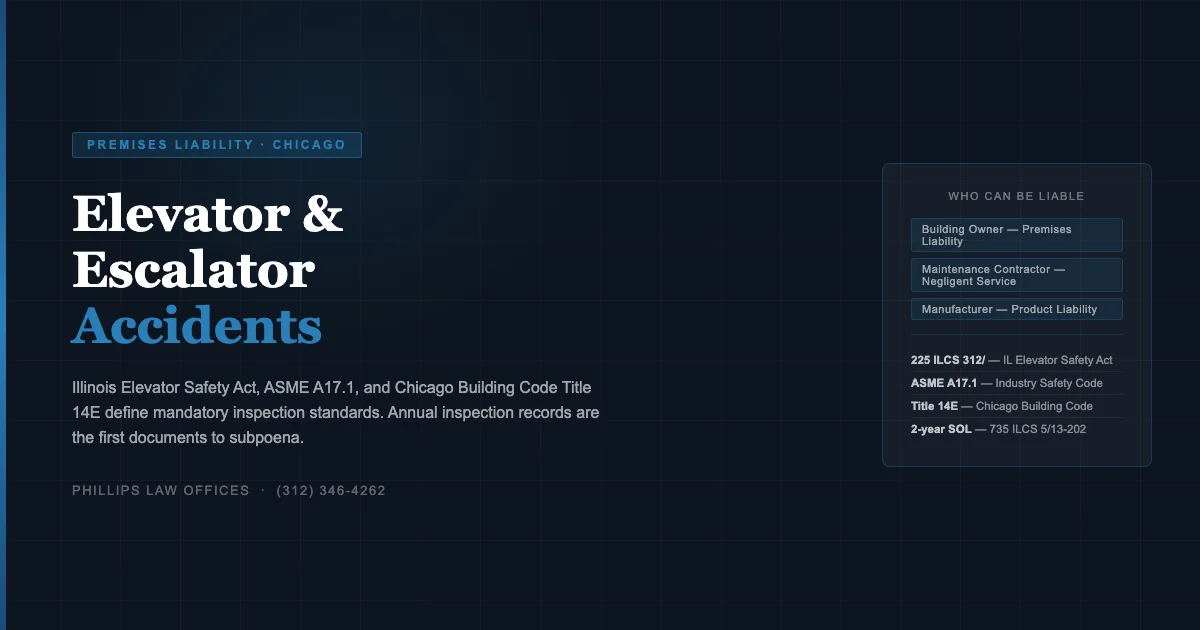
 Short answer: Elevator and escalator injuries in Chicago involve multiple potential defendants: the building owner, the elevator maintenance company, and in some cases the manufacturer. The Illinois Elevator Safety Act (225 ILCS 312/) and the ASME A17.1 Safety Code define mandatory inspection and maintenance standards. When those standards are not met, the inspection and maintenance records are the first documents to subpoena. A Chicago attorney handling these cases must understand both premises liability and product liability theories because most serious elevator and escalator injuries involve elements of both.
In my experience handling premises liability cases in Chicago, elevator and escalator injury claims are underestimated by defense counsel and by courts unfamiliar with the underlying regulatory framework. The paper trail in these cases is extraordinary: every elevator in Illinois is supposed to have a current inspection certificate, a maintenance log, and a history of service calls. When you pull those records in discovery and find that a unit was flagged for mis-leveling six months before a passenger tripped and broke their hip, the negligence becomes very concrete. The challenge is identifying all the parties responsible and not letting any one of them deflect to the others.
The Illinois Elevator Safety Act and ASME A17.1
Illinois regulates elevators and escalators through the Illinois Elevator Safety Act (225 ILCS 312/). The Act requires that every commercial elevator and escalator in Illinois be inspected annually by a licensed elevator inspector and receive a valid certificate of inspection. Operating a commercial elevator without a current certificate is a statutory violation.
Key provisions of the Act relevant to injury claims:
- Annual inspections: Every commercial conveyance must be inspected at least once per year. The inspection must be performed by an inspector licensed under the Act. Certificates are posted inside the elevator cab.
- Licensed contractors: Elevator maintenance and repair work must be performed by contractors licensed under the Act. Unlicensed work is a per se violation.
- Deficiency correction: When an inspector notes a deficiency, the owner must correct it within a specified timeframe. Failing to correct a noted deficiency within that window is strong evidence of ongoing negligence.
- Recordkeeping: Owners and contractors are required to maintain maintenance logs and make them available for inspection. Gaps in the log are significant and often tell their own story.
The technical standard against which elevator and escalator condition is measured is the ASME A17.1 Safety Code for Elevators and Escalators, published by the American Society of Mechanical Engineers. ASME A17.1 sets requirements for safe design, installation, alteration, maintenance, and testing of elevators and escalators. Deviation from ASME A17.1 provisions establishes the standard-of-care breach in both the negligence and product liability contexts.
Chicago adds a third layer of regulation: the Chicago Department of Buildings administers elevator permits, inspections, and certificates under Chicago Building Code Title 14E. Inspection records for Chicago buildings are maintained by the Department of Buildings and are available to the public through a Freedom of Information Act (FOIA) request. Obtaining these records before filing suit often reveals prior violations and the history of citations that defense counsel would prefer to keep out of the case.
Common Elevator and Escalator Injury Types
Chicago elevator and escalator cases arise from a consistent set of equipment failures and maintenance deficiencies:
- Mis-leveling (also called “landing zone” failure): This is the most common elevator injury mechanism. The elevator cab stops with its floor at a different height than the building floor, creating a raised or lowered lip. Passengers step out and trip. Mis-leveling occurs when the leveling system is miscalibrated or worn, a condition that appears in maintenance logs before the injury and can be reproduced during investigation.
- Door malfunctions: Elevator doors that close prematurely, fail to reopen when struck, or close with excessive force cause crush injuries to arms, legs, and hands. Photoelectric and pressure-sensitive door safety devices are required by ASME A17.1; failure to maintain them is a documented breach.
- Escalator step entrapment: The gap between escalator steps and the side skirt panels is a known entrapment hazard. When the gap exceeds ASME A17.1 tolerances, shoes, clothing, and extremities can be pulled in, causing degloving injuries, fractures, and amputations. Anti-entrapment brushes (skirt deflectors) are a required mitigation measure.
- Sudden escalator stop: An escalator that stops without warning causes passengers to pitch forward, resulting in falls with serious head, shoulder, and wrist injuries. Sudden stops are caused by emergency stop button activation, phase loss, or chain and step failures.
- Free fall and drop: Elevator free falls are rare but catastrophic. They result from brake failure, governor malfunction, or cable failure. ASME A17.1 requires multiple redundant safety systems, including safeties that grip the guide rails if the cab descends too rapidly. Failure of these systems is typically a product defect or a maintenance failure, depending on the age of the equipment and the service history.
- Entrapment during power failure: While not always causing physical injury, prolonged entrapment in extreme temperatures has caused heat stroke and cardiac events in elderly or medically vulnerable passengers.
Defendants and Theories of Liability
One of the strategic decisions in an elevator or escalator case is identifying all potentially liable parties. These cases rarely involve only one defendant.
- Building owner (premises liability): The owner of a commercial building in Illinois owes a duty of reasonable care to business invitees, including tenants and their guests. This duty extends to maintaining common areas, including elevators and escalators, in a reasonably safe condition. The owner is liable if they knew or should have known of the defective condition and failed to correct it. For elevators, “should have known” is established through the inspection history: if the maintenance log shows recurring complaints about mis-leveling and the owner failed to escalate the repair order, constructive notice is established.
- Elevator maintenance company (negligent service): Most commercial building elevators are maintained under service contracts. When the maintenance company performed the last inspection or repair and failed to identify or correct the defect that caused the injury, the maintenance company is independently liable for negligent inspection and servicing. This is a professional services negligence claim, not a premises liability claim, which means the analysis of the standard of care centers on the ASME A17.1 provisions and the maintenance contract scope of work.
- Elevator manufacturer (product liability): When the injury is caused by a design defect or manufacturing defect in the elevator or escalator equipment itself, a product liability claim lies against the manufacturer. This theory applies when the equipment malfunctioned in a way that proper maintenance could not prevent, or when a safety system required by ASME A17.1 failed because it was defectively designed or manufactured.
“The maintenance and inspection log is the most important document in any elevator injury case. It tells you who worked on the unit, what problems were identified, which repairs were completed, and which were deferred. In every case I have handled where the maintenance log had gaps or showed a recurring complaint that was never fully resolved, the defense’s ‘no notice’ argument collapsed. Subpoena the log before the unit is serviced or replaced.”
Elevator and Escalator Incident Types and Applicable Liability Theories
| Incident Type | Common Cause | Primary Theory of Liability | Key Evidence |
|---|---|---|---|
| Mis-leveling trip-and-fall | Faulty leveling sensor or worn leveling cam | Premises liability (owner) / Negligent service (contractor) | Maintenance log showing prior mis-level complaints; leveling calibration records |
| Door crush injury | Failed door reversal device; worn clutch mechanism | Premises liability / Negligent service | Door safety device test records; prior incident reports; ASME A17.1 door reversal specs |
| Escalator step entrapment | Excessive skirt panel gap; missing skirt deflectors | Premises liability / Negligent service / Product liability (if design defect) | Gap measurement at time of incident; ASME A17.1 clearance tolerances; inspection reports |
| Sudden escalator stop | Emergency stop activation, phase loss, chain failure | Negligent service / Product liability | Electrical service records; emergency stop log; maintenance history |
| Elevator free fall or drop | Brake failure; governor malfunction; cable failure | Product liability / Negligent service | Component inspection records; governor and brake test logs; ASME A17.1 safety system requirements |
| Entrapment injury | Emergency power system failure; mechanical malfunction | Premises liability / Negligent service | Building emergency power records; entrapment alarm test records; service response time |
Notice and the Role of Inspection Records
Premises liability claims against a building owner require proof that the owner had actual or constructive notice of the defect. In elevator and escalator cases, this element is developed primarily through the maintenance and inspection record:
- Actual notice: Prior complaints from tenants or building staff about the specific condition that caused the injury. A tenant who emailed the building manager two months before the incident reporting that the elevator doors were not reopening properly creates actual notice.
- Constructive notice: The condition existed for a sufficient period that the owner should have discovered it through reasonable inspection. A mis-leveling condition documented in service records over multiple service visits establishes constructive notice even without a specific complaint.
- ASME code violations as notice: When a prior inspection report noted an ASME A17.1 violation and the owner failed to correct it within the required period, the uncorrected violation itself constitutes both the notice and the breach of duty.
Obtaining Chicago Department of Buildings inspection records through a FOIA request before filing suit is critical. These records show whether the building’s elevator certificates were current, whether any violations were cited, and whether correction orders were issued and complied with. An elevator operating with an expired certificate or an uncorrected citation is a powerful fact pattern for establishing both notice and negligence per se.
Who is responsible when an elevator mis-levels and I trip getting off?
Typically both the building owner and the elevator maintenance company share responsibility. The building owner has a duty to maintain common areas in a safe condition and is liable if they had notice of the mis-leveling problem. The maintenance company is liable if the mis-leveling resulted from a failure to properly service the leveling system during a recent visit. In many cases, we name both defendants and let discovery establish which party’s conduct was the primary cause. Chicago’s FOIA records and the maintenance log establish the notice and service history for both defendants.
What should I do immediately after an elevator or escalator injury in Chicago?
If you are physically able, photograph the elevator cab number, the inspection certificate posted inside (note the expiration date and any visible defects), the specific condition that caused your injury, and the floor level. Report the incident to the building’s property manager or security desk and request a copy of any incident report prepared. Seek medical treatment immediately and preserve any clothing that was caught or torn. Contact an attorney before authorizing the building to service or replace the equipment: once the unit is repaired, the physical evidence of the defect may be lost.
Can I sue the elevator manufacturer if the equipment was defective?
Yes. If the injury was caused by a design defect or manufacturing defect in the elevator or escalator itself, rather than by a failure to maintain otherwise sound equipment, a product liability claim against the manufacturer is available. Illinois applies strict liability for product defects under the Restatement (Second) of Torts Section 402A, as adopted in Illinois. You do not need to prove the manufacturer was negligent, only that the product was unreasonably dangerous when it left the manufacturer’s control and that the defect caused your injury.
How long do I have to file an elevator accident lawsuit in Illinois?
The general personal injury statute of limitations in Illinois is two years from the date of the injury under 735 ILCS 5/13-202. For claims against a local government entity (for example, if the accident occurred in a government building), you must file a formal notice of claim within one year under the Local Governmental and Governmental Employees Tort Immunity Act (745 ILCS 10/). Because physical evidence can be destroyed or modified during routine maintenance, the sooner you consult an attorney, the better your ability to preserve the evidence that determines liability.
What damages are recoverable in a Chicago elevator accident case?
Recoverable damages include: past and future medical expenses, past and future lost wages and earning capacity, pain and suffering, disfigurement, loss of a normal life, and emotional distress. For severe injuries requiring surgery, rehabilitation, or long-term care, a life care plan will be necessary to document future medical expenses. Illinois does not cap compensatory damages in personal injury cases. If the defendant’s conduct was egregious, such as knowingly operating an elevator with a documented, uncorrected safety violation, punitive damages may also be available.
Authoritative Sources
- 225 ILCS 312/, Illinois Elevator Safety Act (Illinois General Assembly)
- 735 ILCS 5/13-202, Personal Injury Statute of Limitations (Illinois General Assembly)
- 745 ILCS 10/, Local Governmental and Governmental Employees Tort Immunity Act (Illinois General Assembly)
- Chicago Department of Buildings, Elevator Permits and Inspection Records
- ASME A17.1/CSA B44 Safety Code for Elevators and Escalators
Related Illinois Injury Guides
- Stairway Fall Claims in Chicago Buildings
- Negligent Security Claims in Chicago
- Swimming Pool Accident Claims in Illinois
- Apartment Slip and Fall Claims in Chicago
If you were injured in an elevator or escalator accident in Chicago, call Phillips Law Offices at (312) 346-4262 for a free consultation.