 Written by
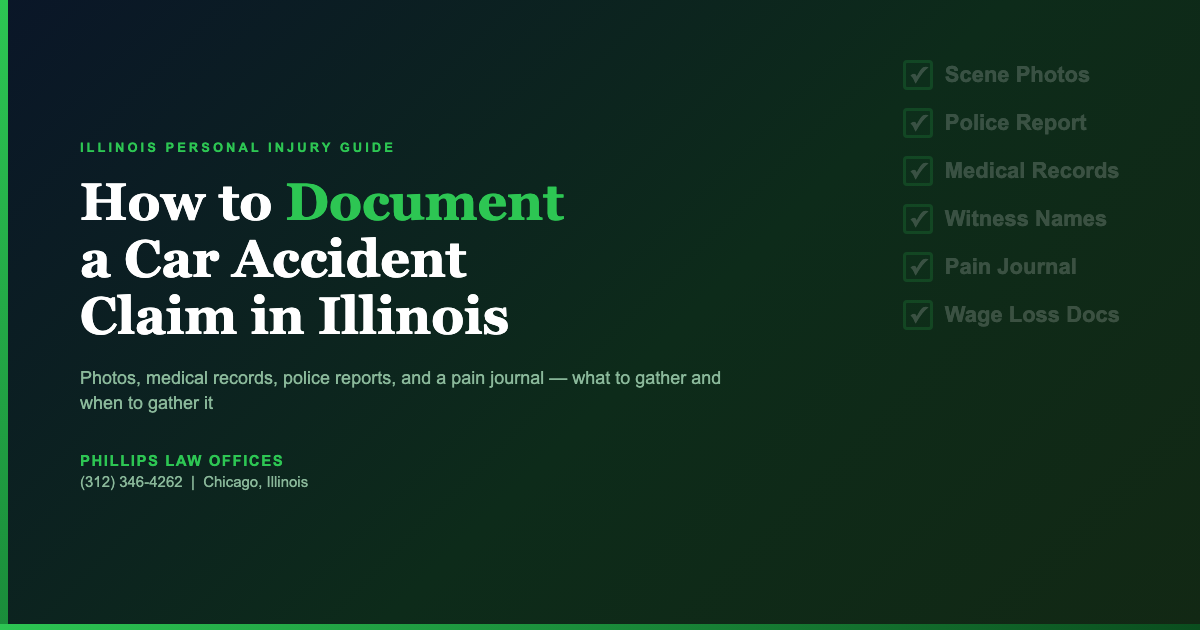
 Short answer: The strength of an Illinois car accident claim is almost entirely built on documentation. From the moment the crash occurs, everything you photograph, record, and preserve becomes potential evidence. A well-documented case puts an insurer on notice that a demand is backed by proof — it discourages lowball offers and gives your attorney the tools to demonstrate exactly what the crash cost you in medical bills, lost income, and quality of life.
In my experience handling Illinois personal injury cases, the clients who arrive with organized documentation — photos, a police report, consistent medical records, and a written account of their symptoms — are in a fundamentally different position than those who delayed treatment or relied on memory alone. Insurers are trained to identify gaps, and every gap is an opportunity for them to minimize your claim. This guide covers what to gather, when to gather it, and why each category of evidence matters.
Documentation at the Accident Scene
The most valuable documentation window is the first 15 to 30 minutes after the crash — before vehicles are moved, before conditions change, and before the physical evidence shifts. Use your smartphone to photograph everything in sight.
Photograph all vehicles involved from multiple angles: front, rear, sides, and close-ups of every point of damage. Include license plates in your photos. Capture the position of each vehicle relative to lane markings and intersections before any vehicle is driven away. Skid marks, debris fields, and gouge marks in the pavement are all physical evidence of the crash mechanics — photograph them even if you are not sure how they will be used later.
Document road and environmental conditions: wet or icy pavement, construction zones, missing or obscured signage, broken traffic signals, or blocked sight lines. Photograph the weather by including the sky in a frame that also shows the road surface.
Collect witness information immediately — full name, phone number, and a brief note on what they observed. Witnesses who leave the scene without sharing their information are effectively lost to your case. If a witness is reluctant to wait for police, ask for their contact information only and let them go.
The Police Report — Why It Matters and How to Obtain It
Under 625 ILCS 5/11-407, Illinois drivers involved in a crash resulting in injury, death, or property damage exceeding $1,500 are required to report the accident. In Chicago, call 911 to bring police to the scene. A crash report (SR-1 or local department report) creates an official record that documents each driver’s account, the officer’s observations, witness names, and a preliminary fault notation. This report is one of the first things an insurance adjuster and opposing counsel will request.
If police respond, request the report number before you leave the scene. Chicago Police Department crash reports can be retrieved through the Illinois State Police online portal or directly from CPD’s Records Division. Review the report when it is available — if it contains factual errors, your attorney can submit a supplement or request a correction.
Medical Documentation — The Most Critical Category
Seek medical treatment on the same day as the crash, or within 24 hours at the latest. Emergency room records, urgent care notes, and ambulance transport reports all create a contemporaneous medical record linking the crash to your injuries. Insurance adjusters and defense attorneys scrutinize the timing between the accident and the first medical visit — a multi-day gap is used to argue that your injuries were not serious enough to prompt immediate care.
Continue attending all scheduled appointments — primary care, specialist referrals, physical therapy, chiropractic care, and mental health counseling. Every missed appointment is documented in the treatment record and will be used to question the severity of your injuries or your compliance with treatment. Keep copies of every billing statement, explanation of benefits, prescription receipt, and therapy discharge summary.
Request itemized billing from every provider. Insurers often challenge lump-sum bills; itemized bills allow your attorney to defend each line item. If you are referred for imaging — X-rays, MRI, CT scan — obtain the imaging reports and, when possible, copies of the actual images on disc.
A one-week gap in medical treatment can cost you more in settlement value than the gap itself costs in medical bills. Insurers use treatment gaps to tell a story: that your injuries resolved on their own, that you were not actually impaired, or that something else caused your later symptoms. Closing that gap requires your treating physician to explain it in writing — which is possible, but far better avoided altogether by maintaining consistent care.
Lost Wages and Employment Documentation
Lost wages are a recoverable element of damages in Illinois personal injury cases, but they require documentation. Your attorney will need: a letter from your employer on company letterhead confirming the dates you missed work and your regular rate of pay; pay stubs from the three to six months before the crash to establish your baseline income; and a physician’s note confirming your medical condition prevented you from working during the claimed period.
If you are self-employed, document lost income through tax returns, client invoices, and bank statements showing the revenue drop. Self-employed lost wages claims require more supporting documentation but are fully recoverable in Illinois.
If you used sick leave or PTO to cover your missed time, you may still have a lost wages claim — consult with your attorney about how PTO usage is handled under Illinois damages law.
Your Pain Journal — Supporting Pain and Suffering Damages
Illinois allows recovery for pain and suffering, loss of enjoyment of life, and emotional distress — categories of damages that are, by definition, subjective. A daily pain journal transforms subjective complaints into a documented, dated record that supports your attorney’s demand and corroborates the medical records.
A pain journal entry should include: the date; a pain level on a 1-10 scale; which parts of your body hurt and how the pain feels; specific activities you could not perform (driving, lifting children, exercising, sleeping); any emotional symptoms (anxiety, depression, irritability, difficulty concentrating); and any medications taken and whether they provided relief.
Keep the journal consistent and honest. Do not write only on bad days — note good days too, as a realistic account is more credible than one that shows unvarying maximum pain. Entries do not need to be long; two or three sentences per day is sufficient.
What Not to Do — Social Media and Recorded Statements
Do not post anything about the accident, your injuries, or your activities on social media from the date of the crash until your case is resolved. Defense attorneys and insurance adjusters routinely monitor plaintiffs’ social media accounts. A photo from a friend’s birthday party posted three weeks after a crash that shows you smiling and standing will be used to contradict claims of ongoing pain or mobility limitations — regardless of context.
Do not give a recorded statement to the at-fault driver’s insurance company without first consulting an attorney. You are not required to give a recorded statement to the opposing insurer. You may be required to cooperate with your own insurer under the terms of your policy, but your attorney should be present for that statement as well.
| Stage | Documentation to Gather | Why It Matters |
|---|---|---|
| At the scene | Photos of all vehicles, plates, road conditions, skid marks; witness names/phones; police report number | Physical evidence disappears within hours; witness memory fades quickly |
| Within 24 hours | ER or urgent care visit; begin pain journal; preserve dashcam footage | Links injuries to crash; closes the gap insurers use to minimize claims |
| First two weeks | Follow-up appointments; employer letter; pay stubs; obtain police report | Establishes treatment continuity and wage-loss basis |
| Ongoing treatment | All billing statements; imaging reports; therapy notes; physician restrictions | Documents total medical damages and functional limitations |
| Case preparation | Compiled pain journal; employment records; any out-of-pocket expenses (Uber to appointments, prescriptions) | Supports pain and suffering demand and out-of-pocket reimbursement |
Frequently Asked Questions
What if I did not get a police report at the scene?
If police did not respond or you did not request a report, you can still file an Illinois Traffic Crash Report (SR-1) directly with the Illinois Department of Transportation. This is required when there is injury or property damage over $1,500. File it promptly — it creates an official record even if it is completed after the fact.
How long should I keep my medical documentation?
Keep all medical records and bills indefinitely until your case is fully resolved. After settlement or verdict, retain the records for at least five years in case of any future dispute about your medical history. If injuries lead to long-term conditions, indefinite retention is prudent.
Can the insurance company access my medical records without my consent?
The opposing insurer cannot access your medical records without your authorization. Be cautious about signing any blanket medical authorization provided by the at-fault driver’s insurer — these broad authorizations can give access to your entire medical history, not just the records related to your crash injuries. Your attorney can provide a limited authorization that covers only the relevant treatment period.
Does it matter if I went to a chiropractor instead of a medical doctor?
Chiropractic records are valid medical documentation and are routinely used in Illinois personal injury claims. However, insurers sometimes challenge cases supported exclusively by chiropractic treatment without any MD evaluation. For significant injuries, it is advisable to have at least one evaluation by a medical doctor or specialist — an orthopedic surgeon, neurologist, or physiatrist — in addition to chiropractic care.
What if I cannot afford medical care while my claim is pending?
Some Illinois personal injury attorneys can refer clients to treating physicians who will accept a letter of protection (LOP) — meaning the physician treats you now and is reimbursed from the settlement proceeds. This allows treatment to continue without out-of-pocket payment. Discuss this option with your attorney at (312) 346-4262.
Authoritative Sources
- 625 ILCS 5/11-407 — Accident Reporting Requirements, Illinois Vehicle Code (ILGA)
- 735 ILCS 5/13-202 — Two-Year Personal Injury Statute of Limitations (ILGA)
- 735 ILCS 5/2-1116 — Comparative Fault, Illinois Code of Civil Procedure (ILGA)
- Illinois Department of Transportation — Crash Reporting Information
Related Illinois Injury Guides
- Lane Change Accident Claims in Chicago — Fault, Evidence, and Recovery
- Should You Accept the First Settlement Offer From an Insurance Company in Illinois?
- Medical Treatment After a Car Accident — What Illinois Injury Victims Should Know
- How Pain and Suffering Damages Are Calculated in Illinois
If you were injured in a car accident in Chicago or the surrounding area, call Phillips Law Offices at (312) 346-4262 for a free consultation. No fee unless we recover for you.