
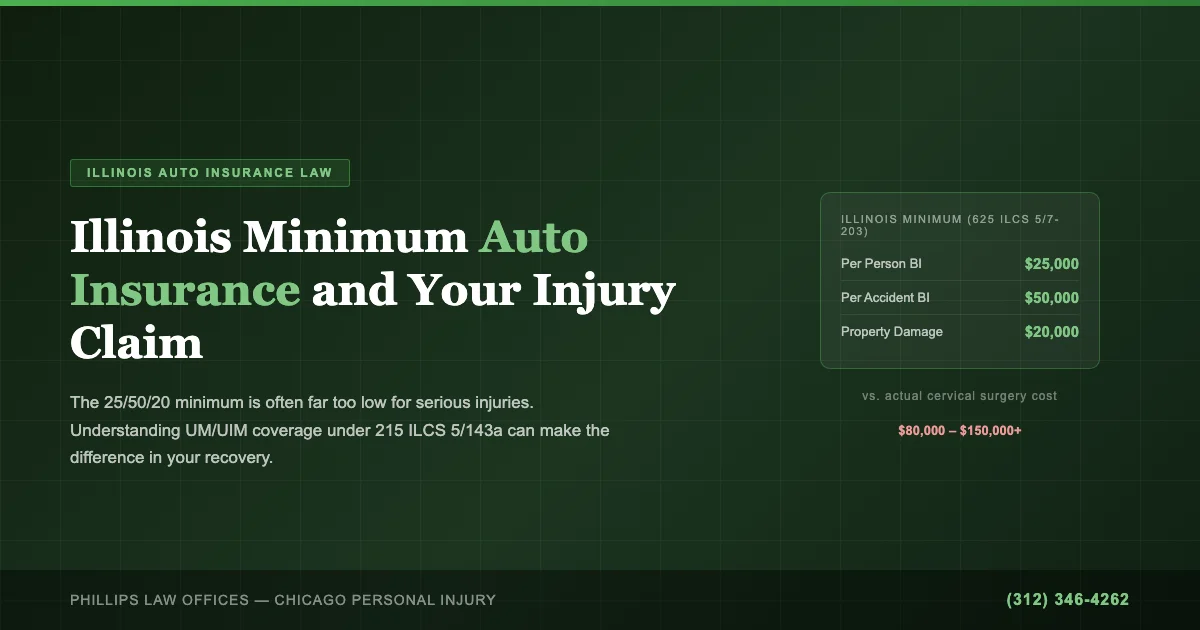
Short answer: Illinois law requires every driver to carry minimum auto insurance of $25,000 per person and $50,000 per accident for bodily injury liability, plus $20,000 for property damage (625 ILCS 5/7-203). These minimums are often far too low to cover serious injuries. A single ER visit, ambulance transport, and two-day hospital stay can exceed $25,000. When the at-fault driver has only minimum coverage, the gap between their policy limit and your actual damages is typically covered by your own underinsured motorist (UIM) policy, if you have it and have not waived it.
In my experience handling Illinois personal injury cases, the at-fault driver’s coverage limits are often the central financial variable in a case. I have resolved cases where a client suffered a herniated disc requiring surgery, the at-fault driver had a $25,000 policy, and the client was left with $150,000 in medical bills. When clients have their own UIM coverage, which Illinois law requires at minimum levels unless waived in writing, we can pursue that gap. When clients waived their UIM coverage without understanding what they were giving up, the options are far more limited. This post explains the Illinois minimum insurance framework and why your own coverage decisions matter as much as the other driver’s.
Illinois Statutory Minimum Auto Insurance Requirements
The Illinois Vehicle Code at 625 ILCS 5/7-203 establishes the minimum liability insurance every Illinois driver must carry:
- $25,000 per person for bodily injury caused to any one person in a single accident.
- $50,000 per accident total for bodily injury when multiple people are injured in the same crash.
- $20,000 per accident for property damage to another person’s vehicle or other property.
These are expressed as a 25/50/20 split-limit policy. The per-person limit applies regardless of how severe that individual’s injuries are, if one person suffers $200,000 in damages and the at-fault driver has a $25,000 minimum policy, the maximum that policy pays toward that person’s injuries is $25,000.
Illinois does not require Personal Injury Protection (PIP) or medical payments (MedPay) coverage. Illinois is an at-fault state, meaning the injured party recovers from the at-fault driver’s liability insurer, not from their own insurer first as in no-fault states. This structure makes the at-fault driver’s policy limits and your own UIM coverage the two most financially significant variables in any serious accident case.
Uninsured and Underinsured Motorist Coverage Under Illinois Law
Illinois requires insurers to offer uninsured motorist (UM) and underinsured motorist (UIM) coverage at minimum limits of 25/50 under 215 ILCS 5/143a. An insured can waive UM/UIM coverage, but only in writing. Insurers are required to offer UM/UIM coverage with every auto policy, the coverage does not appear automatically unless the insured affirmatively selects it or fails to waive it in writing.
Uninsured motorist (UM) coverage applies when the at-fault driver has no insurance at all. According to the Insurance Research Council, roughly 1 in 8 Illinois drivers, approximately 12.5% of drivers statewide, is uninsured. UM coverage steps in to pay your bodily injury damages up to your UM policy limit when the at-fault driver has no coverage.
Underinsured motorist (UIM) coverage applies when the at-fault driver has insurance but their limits are too low to cover your actual damages. The UIM claim is filed against your own insurer for the gap between the at-fault driver’s policy limit and your UIM limit. Illinois requires that UIM coverage limits be at least equal to the UM limits purchased, meaning if you carry 100/300 UM, your UIM cannot be lower than 100/300.
Why Minimum Coverage Is Almost Always Insufficient for Serious Injuries
The $25,000 minimum is a statutory floor set in 1989, before modern healthcare costs. Consider what a moderate car accident injury actually costs in 2024:
- Ambulance transport in Chicago: $1,200 to $3,000.
- Emergency room visit with imaging (CT scan, X-rays): $8,000 to $20,000.
- Two-day inpatient hospital stay: $15,000 to $35,000.
- Cervical spine surgery (anterior discectomy and fusion): $80,000 to $150,000.
- Lumbar surgery: $60,000 to $120,000.
- Six months of physical therapy: $8,000 to $18,000.
A single hospitalization for a fractured vertebra easily consumes a $25,000 minimum policy in its entirety, before any surgical care, rehabilitation, or lost income is accounted for. The at-fault driver’s insurer will tender the full $25,000 limit and close the file. The remaining damages must come from the victim’s UIM coverage, a personal judgment against the at-fault driver (who often has no significant assets), or remain uncollected.
Illinois Minimum Coverage vs. What Common Injuries Actually Cost
| Injury Type | Estimated Medical Cost Range | Illinois Minimum Coverage | Typical Gap |
|---|---|---|---|
| ER visit + concussion workup | $8,000 – $20,000 | $25,000 per person | Covered if no surgery needed |
| Fractured wrist requiring surgery | $25,000 – $60,000 | $25,000 per person | $0 – $35,000 unpaid |
| Herniated cervical disc + surgery | $80,000 – $150,000 | $25,000 per person | $55,000 – $125,000 unpaid |
| Lumbar herniation + physical therapy | $30,000 – $80,000 | $25,000 per person | $5,000 – $55,000 unpaid |
| Traumatic brain injury (moderate) | $100,000 – $300,000+ | $25,000 per person | $75,000 – $275,000+ unpaid |
| Spinal cord injury (incomplete) | $500,000 – $1,000,000+ (lifetime) | $25,000 per person | Nearly all costs unpaid by at-fault policy |
The single most important financial decision you can make after a serious car accident is to pull out your own insurance declarations page and find your UM/UIM limits. Before we talk about the other driver’s coverage, we need to know what you have. I have seen clients with $300,000 in damages walk away with $25,000 because they waived UIM coverage when they purchased their policy without understanding what they were signing. Your own coverage is the safety net the Illinois legislature built into the system precisely for this situation, but only if you actually have it.
Stacking UM/UIM Coverage in Illinois
Some Illinois auto insurance policies allow “stacking” of UM/UIM coverage across multiple vehicles on the same policy. For example, if a household has two vehicles each insured with $100,000 UIM limits, a stacking policy would allow a claimant to access up to $200,000 in UIM coverage in a single accident, combining both vehicles’ limits. Non-stacking policies expressly prohibit this and limit recovery to the highest single-vehicle limit.
Whether your policy stacks is determined by the policy language, not by default. The Illinois Supreme Court has addressed stacking in cases including Bruder v. Country Mutual Insurance Co. Illinois courts generally hold that anti-stacking clauses are enforceable when clearly stated in the policy. Review your declarations page and policy form, or ask your attorney to review it, before accepting that stacking is unavailable to you.
What Happens When the At-Fault Driver Is Completely Uninsured
When the at-fault driver has no insurance at all, the framework shifts entirely to your own UM coverage. The UM claim proceeds against your own insurer, which effectively steps into the shoes of the uninsured driver. Your insurer has an obligation to treat you fairly under the same good faith standards that apply to any liability claim, though in practice, UM claims against your own insurer can involve adversarial negotiation just as a third-party claim would.
If you have no UM coverage, because you waived it or carry only the state minimum, which may be inadequate for your injuries, you can still file a lawsuit against the uninsured driver personally. Collecting a judgment against an individual with no insurance and no significant assets is a separate and often difficult problem. In cases where the uninsured driver has real property, wages subject to garnishment, or other collectible assets, a personal judgment is worth pursuing. In many cases it is not.
Frequently Asked Questions
Can I sue the at-fault driver directly even if they only have minimum insurance?
Yes. You can file a lawsuit against the at-fault driver personally for the full amount of your damages. The at-fault driver’s insurer defends the lawsuit and pays up to the policy limit. Any judgment exceeding the policy limit becomes a personal judgment against the individual. Whether that judgment is collectible depends on the at-fault driver’s assets and income. An attorney can help you evaluate whether personal collection is worth pursuing in your specific situation.
How does Illinois UIM coverage work when multiple people are injured in the same accident?
The per-accident limit on the at-fault driver’s policy is divided among all injured claimants, which can reduce what each person recovers from the at-fault policy. Each injured person then looks to their own UIM coverage for the gap between their pro-rata share of the at-fault policy and their actual damages. If multiple household members were injured, each may have their own UIM claim, and the policy’s per-person and per-accident limits both apply.
What is the difference between UM and UIM coverage in Illinois?
UM (uninsured motorist) coverage applies when the at-fault driver has no insurance. UIM (underinsured motorist) coverage applies when the at-fault driver has insurance but their limits are less than your damages. In Illinois, these are separate coverage components under 215 ILCS 5/143a. Some policies combine them; others separate them. Your declarations page shows which you have and at what limits.
Does Illinois require me to carry more than the minimum coverage?
No. The 25/50/20 minimums are a legal floor, not a recommended level. Most insurance professionals recommend carrying at least 100/300/100 liability coverage and matching UM/UIM limits, and an umbrella policy above that if you have assets to protect. The minimum is what is required to legally operate a vehicle; it is not what is adequate to actually cover serious harm.
How long do I have to make a UIM claim in Illinois?
The statute of limitations for a personal injury claim in Illinois is two years under 735 ILCS 5/13-202. UIM claims against your own insurer are generally governed by the policy’s terms, which may include their own notice and claim deadlines. Most policies require prompt notice of a potential UIM claim, even before the underlying at-fault claim is resolved. Notify your own insurer of a potential UIM claim as soon as you know the at-fault driver’s limits are inadequate, do not wait until the at-fault claim is settled.
Authoritative Sources
- 625 ILCS 5/7-203, Illinois Vehicle Code, Required Liability Insurance Minimums
- 215 ILCS 5/143a, Illinois Insurance Code, Uninsured/Underinsured Motorist Coverage
- 735 ILCS 5/13-202, Personal Injury Statute of Limitations
- 735 ILCS 5/2-1116, Illinois Modified Comparative Fault
Related Illinois Injury Guides
- Using Dashcam Footage in a Chicago Car Accident Claim
- Spinal Cord and Back Injury Claims in Illinois
- Future Medical Expenses in Illinois Personal Injury Cases
- How Illinois Courts Calculate Pain and Suffering Damages
If you were seriously injured in an Illinois car accident and the at-fault driver’s coverage is inadequate for your damages, contact Phillips Law Offices at (312) 346-4262 for a free consultation. We review your own policy’s UM/UIM coverage, evaluate stacking options, and pursue every available source of recovery for your injuries.
This guide is part of our Hiring a Chicago Injury Lawyer section, where you can find every related guide on this site.
For how claims are valued, negotiated and paid out, see our guide to settlements and compensation.