
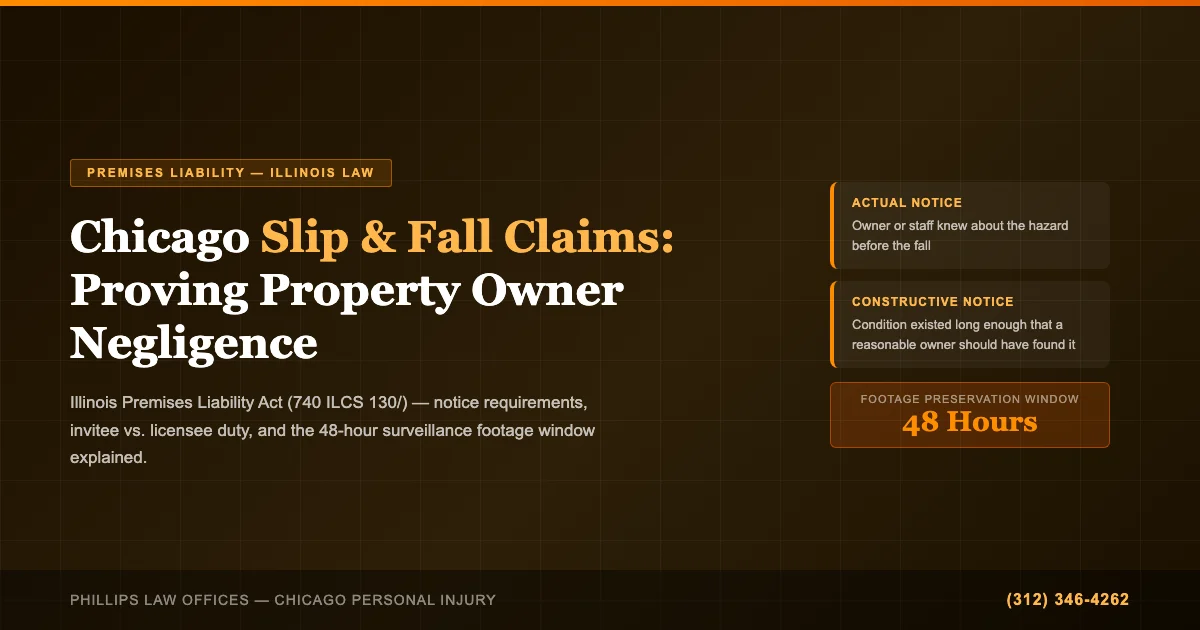
Short answer: Chicago slip and fall claims are governed by the Illinois Premises Liability Act (740 ILCS 130/) and require proving that the property owner knew or should have known about the hazardous condition and failed to remedy it within a reasonable time. The legal duty owed depends on your status on the property: invitees (business visitors) receive the highest duty of care; licensees (social guests) receive a lesser duty; trespassers receive only a duty to refrain from willful and wanton conduct in most circumstances. Notice, either actual or constructive, is the element that most often makes or breaks a slip and fall claim in Illinois.
In my experience handling Illinois personal injury cases, slip and fall claims are among the most defensible cases in a plaintiff’s lawyer’s practice, not because the injuries are minor, but because the notice element gives defense attorneys real room to argue. The defendant’s insurer almost always argues that the condition appeared suddenly, was obvious, or did not exist long enough for anyone to have known about it. Building a compelling notice case takes immediate, specific evidence gathering at the scene. This post explains the legal framework, how notice works in practice, and what the first 48 hours after a fall need to accomplish.
Illinois Premises Liability Act, The Legal Framework
The Illinois Premises Liability Act at 740 ILCS 130/ codified and modified the common law of premises liability in Illinois. Under the Act:
- The duty owed by a landowner to persons on their property is determined by the standard of reasonable care under the circumstances, as in an ordinary negligence case.
- The distinction between invitees and licensees, while still relevant to the scope of the duty, no longer automatically bars recovery based on entry status alone in the way the old common law did.
- The Act abolished the separate “attractive nuisance” doctrine and absorbed it into the general negligence standard for child entrants.
- Trespassers still receive a lower duty of care, the landowner must refrain from willful and wanton conduct, but is not required to make the premises safe for unauthorized entrants. Children who trespass may be entitled to more protection under the general negligence standard if the hazard was known to attract children.
Practical effect: in most Chicago slip and fall cases involving a business invitee, a store customer, restaurant guest, gym member, or office visitor, the legal question is whether the property owner acted as a reasonably careful owner would have acted in discovering and remedying the hazardous condition. The standard is not perfection. It is reasonable care.
Invitee, Licensee, and Trespasser, Why Your Status Matters
Although Illinois has moved toward a unified negligence standard under the Premises Liability Act, the invitee/licensee/trespasser framework still influences what conduct satisfies the duty of reasonable care in practice.
Invitees are persons on the property for a business or commercial purpose: grocery store customers, restaurant patrons, hotel guests, retail shoppers, patients in a medical office, or visitors to a commercial building. The owner owes the highest duty, actively inspecting the premises, discovering hazards, and remedying them or warning of them promptly. A store owner who does not have a routine floor inspection protocol may be liable not just for known conditions but for conditions that a reasonable inspection would have found.
Licensees are persons on the property with permission but not for a commercial purpose, a social guest, a neighbor cutting through a yard, or an off-duty employee visiting a coworker. The owner must warn licensees of known dangers that the licensee would not reasonably discover on their own, but the owner does not have an affirmative duty to inspect for unknown hazards.
Trespassers are persons on the property without permission. The owner must refrain from willful and wanton conduct, setting traps, for example, but generally owes no duty to make the premises safe for trespassers.
The Notice Requirement, Actual vs. Constructive
The element of notice is where most slip and fall claims in Illinois succeed or fail. The plaintiff must prove that the property owner had notice of the hazardous condition, either actual or constructive, before the fall.
Actual notice means the property owner or their employees were aware of the specific condition before the fall. Examples: a store employee saw liquid spilled on the floor, an employee received a customer complaint about the wet spot, a maintenance log shows a prior report of the same condition. Actual notice is the stronger case because it eliminates the “we didn’t know” defense entirely.
Constructive notice means the condition existed for long enough that a property owner exercising reasonable care should have discovered it through regular inspection. The critical variable is time: a spill that occurred two minutes before the fall may not support constructive notice; the same spill that had been on the floor for 45 minutes, was surrounded by a wide water ring from spreading, and was located near a leaking fixture almost certainly does. Illinois courts look at:
- How long the condition had been present, established through surveillance footage, employee testimony, or physical evidence of the condition’s age (dried edges on a spill, footprints through liquid, etc.).
- Whether the condition was foreseeable and should have been inspected for, a grocery store in the produce aisle should anticipate water runoff from the misting system.
- Whether the owner had a regular inspection and cleaning protocol, and whether it was actually followed.
Chicago Weather Hazards and Sidewalk Liability
Chicago’s climate creates predictable seasonal slip and fall hazards. Wet floors from tracked-in rain or snow during winter months are a category of their own, courts recognize that a retail store during a Chicago winter will have wet floors near the entrance, which is precisely why the owner’s duty includes placing adequate anti-slip matting, wet floor signs, and conducting more frequent inspections during precipitation events.
Outdoor sidewalk claims involve a separate and more complicated framework. Under 745 ILCS 10/, the Illinois Tort Immunity Act, the City of Chicago and other governmental entities enjoy immunity from many premises claims, but not all. For sidewalk defect claims against the City of Chicago, 65 ILCS 5/3.1-2-209 requires that the City have received actual written notice of the defect before the fall, and the statute of limitations for claims against the City is one year rather than the standard two. Private property owners adjacent to a sidewalk may also have liability for failing to clear snow and ice under the Chicago Municipal Code if their negligent removal worsened the condition.
Common Slip and Fall Scenarios, Duty, and How Notice Is Established
| Scenario | Entrant Status | Duty Owed | How Notice Is Typically Established |
|---|---|---|---|
| Spilled liquid in grocery store aisle | Invitee | Inspect, discover, remedy or warn | Surveillance footage showing spill duration; employee inspection logs; spreading puddle appearance |
| Wet floor from tracked-in snow near store entrance | Invitee | Inspect, discover, remedy or warn | Foreseeability from weather; absence of adequate matting or signage; inspection frequency during precipitation |
| Broken floor tile in restaurant | Invitee | Inspect, discover, remedy or warn | Visible deterioration suggesting long duration; prior customer complaints; lack of maintenance records |
| Uneven pavement in private parking lot | Invitee | Inspect, discover, remedy or warn | Visible cracking and settling inconsistent with recent origin; prior incident reports; property inspection records |
| Icy patch on private sidewalk | Invitee or licensee | Reasonable care; warning of known dangers | Duration since last weather event; absence of salting or plowing; prior complaints |
| Defective step on apartment building common stairway | Licensee (tenant) | Warn of known dangers; Illinois RLTO requires maintenance | Prior maintenance requests from tenant; written notice to landlord; visible deterioration duration |
| City sidewalk defect (uneven slab) | N/A (public way) | Actual written notice to City required | Prior 311 service request or written complaint to City before the fall |
The surveillance footage demand letter is the most important document you need to send in the first 48 hours after a slip and fall, more important than any phone call to an insurance company, more important than any incident report. Business security cameras typically overwrite every 24 to 72 hours. Once that footage is gone, you may not be able to prove how long the condition existed. When I am retained on a slip and fall case, the first thing we do is identify every camera in the vicinity and send a written preservation demand that same day. If a business receives a preservation demand and then allows the footage to be overwritten, Illinois courts recognize that as spoliation, and the jury gets to hear about it.
Critical First Steps After a Chicago Slip and Fall
Evidence in slip and fall cases is highly perishable. The business will clean the spill. They will repair the broken tile. They may not preserve the footage. Here is what matters in the first hours after a fall:
- Photograph the hazard before anything is cleaned or moved. Take wide-angle shots of the area and close-up shots of the specific condition. Photograph any “wet floor” signs, or the absence of them. Photograph the lighting conditions.
- Do not let them clean it up before you document it. If store staff immediately move to mop the area, tell them you need to document the scene first. Take photographs as quickly as possible.
- Report the incident and request a copy of the incident report. Ask for the manager, report the fall, and request a written copy of the incident report before you leave. Get the manager’s name and direct contact information.
- Get witness information. Other customers, employees not involved in the clean-up, or bystanders who saw the condition or the fall should be identified by name and contact information immediately.
- Seek medical care. Even if you feel you may not be seriously injured, go to an emergency room or urgent care. Many soft tissue and internal injuries are not immediately painful due to adrenaline. Documentation of injury onset is critical for connecting the fall to your medical condition.
- Send a preservation demand for surveillance footage within 24-48 hours. Via certified mail and email to the business owner and their insurance carrier. Identify the date, time, and location and demand preservation of all footage from any camera covering the area.
Frequently Asked Questions
How long do I have to file a slip and fall lawsuit in Illinois?
Two years from the date of the fall under 735 ILCS 5/13-202. If the responsible party is the City of Chicago or another governmental entity, the deadline is one year and there are additional notice requirements. Do not assume you have time, retain an attorney as soon as possible so that evidence can be preserved during the period when it still exists.
What if I was partially at fault for the fall, looking at my phone, for example?
Illinois follows modified comparative fault under 735 ILCS 5/2-1116. You can recover as long as your own fault does not exceed 50%. If a jury finds you 25% at fault for looking at your phone, your damages are reduced by 25%. If they find you 51% at fault, you recover nothing. Defense attorneys routinely argue distraction, inappropriate footwear, and familiarity with a known hazard. An experienced attorney anticipates these arguments and builds the case accordingly.
Does a “wet floor” sign completely protect a business from liability?
No. A wet floor sign can be evidence that the business was aware of the condition and warned of it, which is relevant to the duty analysis. But the sign does not automatically eliminate liability. If the sign was placed in the wrong location, was not visible from the direction of approach, or if the underlying hazard was so dangerous that a warning was insufficient (a spill covering an entire aisle with no dry path around it), the sign does not end the inquiry. The adequacy of the warning is itself a factual question for the jury.
Can I sue a city or government entity for a slip and fall on a public sidewalk?
Possibly, but the rules are significantly different. Under the Illinois Tort Immunity Act (745 ILCS 10/), governmental entities have broad immunity from premises claims. Sidewalk defect claims against the City of Chicago require that the City had prior written notice of the specific defect before the fall. The statute of limitations is one year, not two. If you fell on a City of Chicago sidewalk, consult an attorney within days, the shorter limitations period and notice requirements can eliminate a valid claim if not acted on promptly.
What damages can I recover in an Illinois slip and fall case?
Illinois allows recovery of all economic and non-economic damages proven at trial: past and future medical expenses, lost wages and earning capacity, and non-economic damages including pain and suffering, disability, and loss of normal life. There is no cap on compensatory damages in Illinois personal injury cases. The severity and permanence of the injury, whether you suffer a sprained wrist or a fractured hip requiring surgery and long-term physical therapy, drives the range of recovery.
Authoritative Sources
- 740 ILCS 130/, Illinois Premises Liability Act
- 745 ILCS 10/, Illinois Tort Immunity Act
- 65 ILCS 5/3.1-2-209, Written Notice Requirement for City Sidewalk Claims
- 735 ILCS 5/13-202, Personal Injury Statute of Limitations
- 735 ILCS 5/2-1116, Illinois Modified Comparative Fault
Related Illinois Injury Guides
- Chicago Apartment Slip and Fall, Landlord Liability in Illinois
- Stairway Falls in Chicago Buildings, Illinois Premises Liability
- How Illinois Courts Calculate Pain and Suffering Damages
- Illinois Personal Injury Statute of Limitations: Deadlines You Can’t Miss
If you were injured in a Chicago slip and fall and need help building a notice case, contact Phillips Law Offices at (312) 346-4262 for a free consultation. We investigate conditions immediately, send surveillance footage preservation demands the same day, and handle the full range of Illinois premises liability claims.
This guide is part of our Chicago Premises Liability Claims section, where you can find every related guide on this site.