
Tag: insurance claim tactics
-
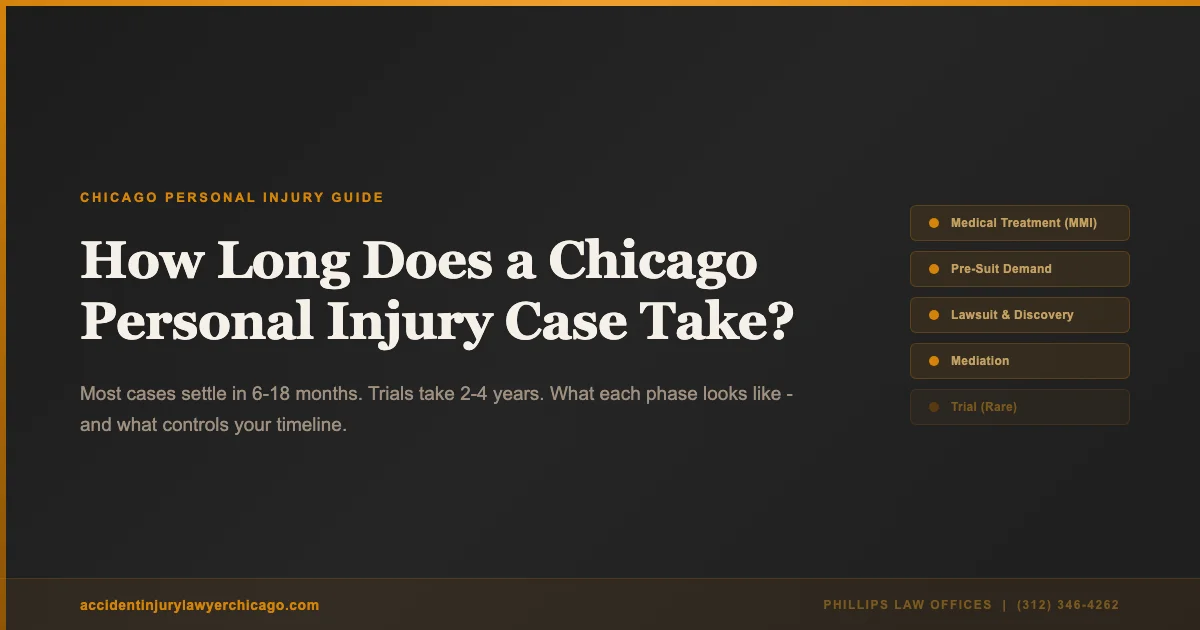
How Long Does a Chicago Personal Injury Case Take?
Most Chicago personal injury cases settle in 6 to 18 months. Cases that go to trial take 2 to 4 years. The timeline depends on injury…
-
Surgical Never Events in Illinois Hospitals
Surgical never events — wrong-site surgery, retained objects, wrong patient, wrong procedure — are so clearly preventable that Illinois courts treat them as near-automatic proof of…
-
Anesthesia Errors in Illinois Hospitals and Surgery Centers
Attorney guide to Illinois anesthesia malpractice: common errors, the anesthesia record as evidence, proving the breach, and the catastrophic injuries that follow.
-
How Much Does a Chicago Personal Injury Lawyer Cost?
Attorney guide to Illinois personal injury legal fees: standard contingency rates, what’s included, case costs explained, and a worked example of net recovery.
-
Who Can File a Wrongful Death Claim in Illinois?
Attorney guide to wrongful death standing in Illinois: who can be appointed personal representative, opening the probate estate, the next-of-kin hierarchy, and the survival action distinction.
-
Chicago Apartment Building Slip-and-Fall Claims: Landlord Liability
Attorney guide to Chicago apartment building slip-and-fall claims: landlord duty in common areas, the notice requirement, Illinois snow and ice rules, and 48-hour evidence preservation.
-
Failure to Diagnose Cancer in Illinois Medical Malpractice
Attorney guide to Illinois failure-to-diagnose cancer claims: standard of care, recurring scenarios, the 4-year repose trap, causation proof, and how stage difference drives case value.
-
ERISA Liens on Illinois Personal Injury Settlements
Attorney guide to ERISA self-funded plan liens on Illinois personal injury settlements: why ERISA preempts state law, what controls the lien, and the levers that reduce…
-
Illinois Eggshell Plaintiff Rule: Pre-Existing Injuries and Recovery
Attorney guide to the Illinois eggshell plaintiff rule: how aggravation cases work, what the insurance carrier argues, and how to develop the medical proof.
-
Negligent Security Claims in Chicago Bars and Hotels
Attorney guide to negligent security claims in Chicago bars, hotels, apartment complexes, and parking garages: foreseeability test, recurring scenarios, and 30-day evidence preservation.