 Written by
 Short answer: Loss of future earnings is one of the largest and most contested components of a personal injury damages claim in Illinois. It covers the income and earning capacity you will lose over the rest of your work life because of your injury. Proving it requires an economist, a vocational expert, and specific evidence about your pre-injury career trajectory. The defense will fight every assumption your expert makes — and having a lawyer who understands how that fight plays out is what separates an adequate settlement from a full one.
I work on the damages side of these cases with real regularity, and I want to be candid about why future earnings calculations are so frequently contested. Defense lawyers know that jurors struggle to evaluate projections about income decades into the future. Every assumption an economist makes — your expected raises, your work life expectancy, the discount rate applied to bring future dollars into present value — is a target. The defense will hire their own economist to attack each one. Understanding how that battle works helps you understand what your lawyer needs to build before trial.
What Loss of Future Earnings Covers
Illinois law allows injured plaintiffs to recover for the earning capacity they have lost — not simply the wages they have missed so far, but the income stream they would have generated over their remaining work life. This is distinct from past lost wages, which compensate for income already foregone between the injury and the trial or settlement.
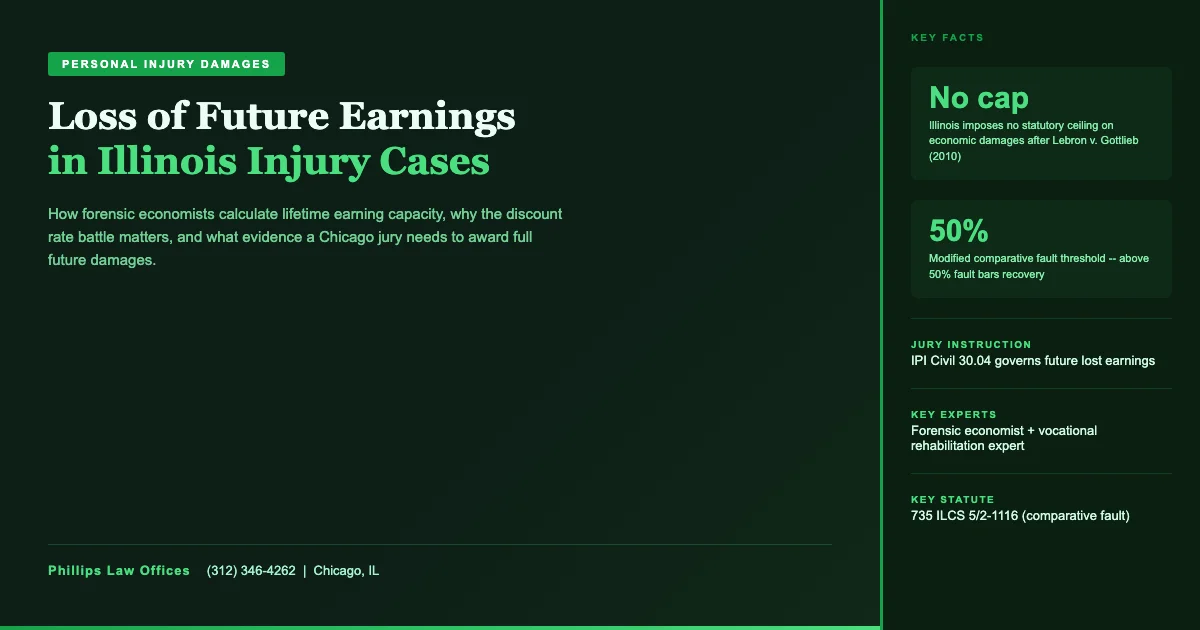
Future earning capacity includes base salary, expected promotions and raises, bonuses, commissions, overtime, and the monetary value of employer-provided benefits. For plaintiffs who cannot return to any work, it also includes the replacement cost of household services that the injured person can no longer perform. Illinois Pattern Jury Instruction (IPI) Civil 30.04 governs how future lost earnings are presented to a Chicago jury.
For plaintiffs who can return to some but not all work — for example, a construction supervisor now limited to sedentary jobs — the calculation covers the gap between what they would have earned in their pre-injury occupation and what they can realistically earn in their reduced capacity. This is sometimes called diminished earning capacity rather than total loss of earnings.
How Economists Calculate Future Lost Earnings
A forensic economist retained to calculate future lost earnings begins with a set of core inputs, applies assumptions grounded in Bureau of Labor Statistics data and actuarial tables, and produces a present-value figure that represents the lump sum a jury could award today to compensate for decades of lost future income.
| Factor | What It Represents | How It Is Established |
|---|---|---|
| Pre-Injury Base Earnings | Annual income at time of injury | Tax returns, pay stubs, employer records |
| Work Life Expectancy | Statistical years remaining in the workforce | BLS worklife expectancy tables by age and education |
| Earnings Growth Rate | Expected annual wage increases | BLS Employment Cost Index; industry wage surveys |
| Discount Rate | Rate used to convert future dollars to present value | U.S. Treasury bond yields; risk-adjusted rates |
| Fringe Benefits | Employer health insurance, retirement contributions, payroll taxes | BLS Employer Costs for Employee Compensation data |
| Household Services | Value of domestic labor plaintiff can no longer perform | Dollar-value-of-a-day tables; replacement cost surveys |
The economist reduces projected future earnings to their present value — this is required under Illinois law to avoid awarding a windfall. A dollar received today is worth more than a dollar received in twenty years because today’s dollar can be invested. The discount rate applied in this reduction is one of the most fought-over assumptions in the entire damages calculation.
The Role of a Vocational Expert
In cases where the plaintiff retains some work capacity, the economist cannot work alone. A vocational rehabilitation expert evaluates the plaintiff’s education, work history, transferable skills, and the functional limitations documented by treating physicians. The vocational expert then identifies what jobs, if any, are realistically available to the plaintiff in the post-injury labor market and at what wage.
The economist takes the vocational expert’s earnings estimate for the reduced-capacity occupation and computes the present value of the gap between the pre-injury earnings trajectory and the post-injury earnings trajectory over the plaintiff’s remaining work life. That gap — expressed as a present-value lump sum — is the future earning capacity loss presented to the jury.
Vocational experts are particularly important in spinal cord and traumatic brain injury cases, where the functional limitations are significant but not always total. They are also critical in cases involving chronic pain where the plaintiff’s ability to sustain full-time employment is compromised even if specific job tasks remain technically possible.
How Defense Experts Challenge the Calculation
Defense economists attack future earnings calculations at every input. Common defense strategies include:
- Higher discount rate: A higher discount rate means future earnings are reduced more aggressively to present value, shrinking the award. Defense experts typically argue for a higher rate than plaintiffs’ experts, and the difference of even one percentage point can shift the present value of a 30-year earnings stream by tens of thousands of dollars.
- Lower earnings growth rate: Defense experts argue that the plaintiff’s earnings would not have grown as fast as the plaintiff’s expert projects, often citing industry-specific data or the plaintiff’s own pre-injury earnings history.
- Shorter work life expectancy: Defense experts may argue the plaintiff would have retired earlier based on age, health history, or industry norms.
- Mitigation: Under Illinois law, injured plaintiffs have a duty to mitigate damages. If a plaintiff refuses reasonable medical treatment or declines a job they are capable of performing, the defense can argue that post-injury earnings should be higher than the plaintiff claims.
- Pre-existing conditions: Defense experts argue that pre-injury health issues or career instability would have reduced the plaintiff’s future earnings even without the injury.
“The discount rate battle is often where cases are won or lost at trial. A plaintiff’s economist using a 1.5% net discount rate and a defense economist using a 3% net discount rate are telling two completely different stories about what the plaintiff lost. The difference can be six figures on a 25-year earnings projection. We prepare our clients to understand this fight long before we get to the courtroom.”
Presenting Future Earnings to a Chicago Jury
Numbers this large, and projections this far into the future, can feel abstract to a jury. Effective presentation requires connecting the economic analysis to the plaintiff’s real story. We pair the economist’s testimony with the plaintiff’s own account of their career aspirations, with employer testimony about their trajectory before the injury, and with evidence about the specific limitations that now prevent them from continuing on that path.
Visual aids — timelines comparing the pre-injury career path against the post-injury reality, charts showing the earnings gap year by year — are essential to making the damages concrete. Illinois courts permit these aids under appropriate foundation, and experienced plaintiff’s attorneys use them routinely.
Under 735 ILCS 5/2-1116, Illinois applies a modified comparative fault rule. If the plaintiff is found more than 50% at fault for the accident, they cannot recover. If they are found partially at fault but not more than 50%, their damages — including future earnings — are reduced proportionally. Defense attorneys will attempt to assign fault to the plaintiff in part to reduce the future earnings award, so anticipating and rebutting that strategy is part of trial preparation.
Frequently Asked Questions
Can I recover future earnings if I was not working at the time of the injury?
Yes. Illinois law allows recovery for lost earning capacity, not just lost wages from a current job. If you were between jobs, temporarily unemployed, a student, or a stay-at-home parent, you can still present evidence of your pre-injury skills, education, and earning potential to establish what capacity the injury has taken from you. The calculation is more complex without a current employer’s records to anchor it, but it is not foreclosed.
How are self-employed future earnings calculated?
Self-employed plaintiffs present additional complexity because their earnings fluctuate and are reflected in business income rather than a W-2. The economist typically uses three to five years of tax returns, Schedule C or business financial statements, and industry benchmarks to establish average pre-injury earnings and a realistic growth trajectory. Accountants familiar with small business valuation are sometimes retained alongside economists for these cases.
What is the difference between lost wages and lost earning capacity?
Lost wages are the specific income you did not receive because the injury prevented you from working — this is a past damages element calculated from the date of injury to the date of trial or settlement. Lost earning capacity is a future damages element covering the income stream you will not be able to generate going forward. Both are recoverable in Illinois personal injury cases, but they require different evidence and different expert methodologies.
Does Illinois cap future earnings damages?
Illinois does not impose a statutory cap on economic damages including future lost earnings in personal injury cases. The Illinois Supreme Court struck down a prior cap on non-economic damages in Lebron v. Gottlieb Memorial Hospital (2010). What limits the future earnings award in practice is the strength of the expert testimony and the jury’s assessment of credibility and causation — not a legislative ceiling.
How do I prove what I would have earned?
Proof comes from multiple sources: your tax returns and pay stubs for the years before the injury; testimony from your employer about your performance reviews, promotions, and expected trajectory; expert testimony from a vocational expert and forensic economist; Bureau of Labor Statistics data for your occupation; and, for younger plaintiffs, educational records and career counselor testimony about expected career paths. The more documentary evidence you can assemble, the stronger the foundation for the expert’s projections.
Authoritative Sources
- 735 ILCS 5/2-1116 — Illinois modified comparative fault rule
- Illinois Pattern Jury Instruction (IPI) Civil 30.04 — Future lost earnings instruction
- Bureau of Labor Statistics — Worklife expectancy tables and employment cost index
- Lebron v. Gottlieb Memorial Hospital, 237 Ill.2d 217 (2010) — Striking Illinois damages cap
Related Illinois Injury Guides
- Future Medical Expenses in Illinois Personal Injury Cases
- Pain and Suffering Damages in Illinois
- Structured Settlements in Illinois
- Are Personal Injury Settlements Taxed in Illinois?
If your injury has affected your ability to work and earn — now or in the future — contact Phillips Law Offices to discuss your damages. Call (312) 346-4262 for a free consultation. We work on contingency — no fee unless we recover for you.