
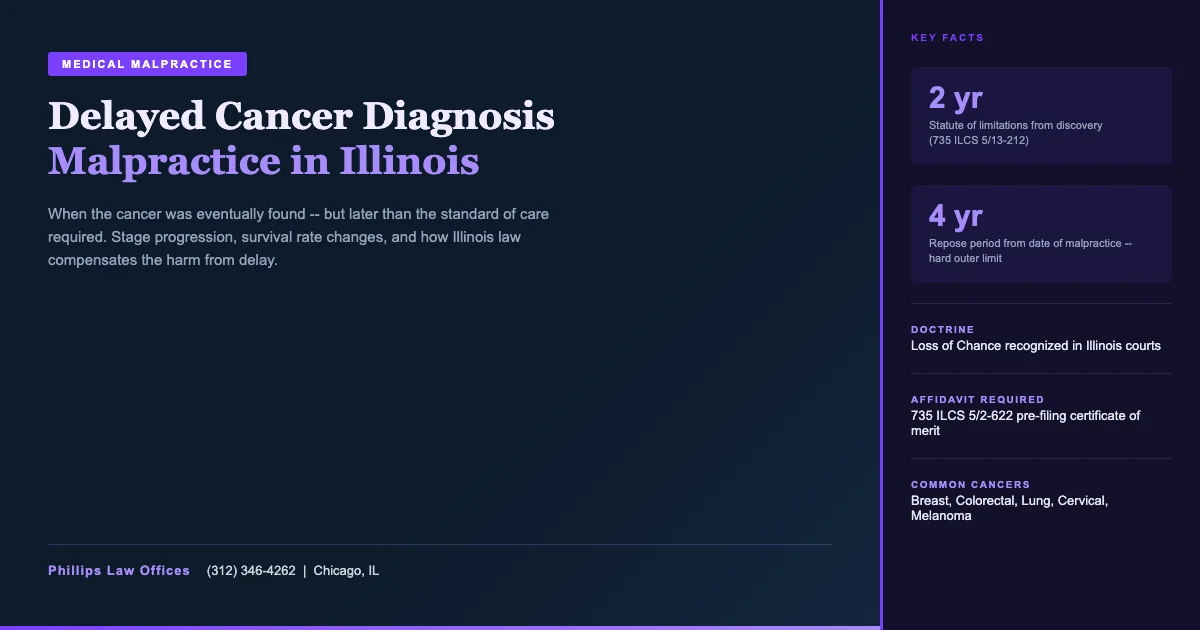
Short answer: Yes, a delayed cancer diagnosis can be medical malpractice in Illinois even if the cancer was eventually caught. The legal question is not whether your doctor found the cancer eventually — it is whether the delay caused measurable harm, such as a shift to a higher stage, a reduction in your survival odds, or the need for more aggressive treatment you could have avoided. Our firm handles these cases throughout Chicago and Illinois.
I want to be direct about something that trips up many potential clients. There is a critical legal difference between a complete failure to diagnose cancer and a delayed diagnosis. In a failure-to-diagnose case, the doctor never identified the cancer at all. In a delayed diagnosis case, the cancer was eventually found, but it should have been identified earlier — and the gap between when it was caught and when it should have been caught is where the legal harm lives. That distinction matters enormously to how we build the case, what experts we retain, and what damages we seek.
How a Delayed Diagnosis Becomes Malpractice
Not every late cancer diagnosis is malpractice. Malpractice requires proof that the treating physician or radiologist deviated from the accepted standard of care for a similarly trained physician under similar circumstances. The standard of care defines what a reasonably competent physician should have done: ordered a particular test, followed up on an abnormal result, referred the patient to a specialist, or performed a biopsy within a defined timeframe.
In delayed diagnosis cases we typically see the following failures: a radiologist who flags a suspicious mass as likely benign when established guidelines require biopsy; a primary care physician who dismisses a patient’s complaints of blood in stool for months without ordering a colonoscopy; or a gynecologist who does not follow up on an abnormal Pap result. In each scenario, the cancer existed, the signals were present, and a competent physician should have acted sooner.
Once we establish a deviation from the standard of care, we must also prove that the deviation caused harm. This causation requirement is what makes delayed diagnosis cases genuinely complex — and it is addressed in depth below.
Cancer Types Most Often Involved in Delay Cases
Some cancers are more frequently associated with delayed diagnosis claims because they have established, evidence-based screening protocols that physicians are expected to follow. When those protocols are not followed and a diagnosis is delayed, the resulting harm is measurable and traceable.
| Cancer Type | Typical Screening Standard | What a Delay Often Causes |
|---|---|---|
| Breast Cancer | Annual mammogram starting at age 40 (ACS); earlier for high-risk | Stage I to Stage II or III progression; mastectomy instead of lumpectomy |
| Colorectal Cancer | Colonoscopy starting at age 45; earlier if symptomatic | Localized tumor becomes regionally or distantly metastatic |
| Cervical Cancer | Pap smear every 3 years (21-65); HPV co-test every 5 years | Carcinoma in situ advances to invasive cancer requiring radiation |
| Prostate Cancer | PSA discussion at age 50; 45 for high-risk patients | Organ-confined cancer becomes extraprostatic; curative surgery no longer viable |
| Melanoma | Annual skin exam; biopsy of changing lesions | Clark Level II lesion advances to lymph node involvement |
| Lung Cancer | Annual low-dose CT for high-risk smokers (USPSTF) | Stage I resectable tumor becomes Stage III or IV unresectable |
Proving Causation — The Hardest Part
Every delayed cancer diagnosis case rises or falls on causation. The defense will argue that even if the doctor should have caught the cancer sooner, it would not have changed the outcome. Overcoming that argument requires oncology and epidemiology experts who can testify about stage-specific survival data, the biology of the particular cancer, and the expected growth rate over the delay period.
“Illinois courts have recognized the ‘loss of chance’ doctrine in medical malpractice cases. Under that doctrine, a plaintiff does not need to prove the delay caused certain death or certain harm — only that it reduced a measurable chance of a better outcome. We build these cases around the specific survival statistics for the cancer at the stage it was found versus the stage it would have been found at with timely diagnosis. The difference in those probabilities is the recoverable harm.”
In practical terms, if your breast cancer was Stage I when eventually diagnosed but should have been caught six months earlier when it was still a small, non-invasive lesion, our expert will testify about the 5-year survival rate for each stage and what the delay cost you in terms of probability and treatment burden. That testimony is what gives the jury a concrete way to value the harm.
Illinois requires that the expert’s testimony meet the standard set under 735 ILCS 5/2-622 — which mandates an affidavit from a qualified health professional confirming there is reasonable and meritorious cause before the case proceeds. We obtain that affidavit as part of our pre-filing review.
Illinois Statute of Limitations for Delayed Diagnosis
Under 735 ILCS 5/13-212, the statute of limitations for medical malpractice in Illinois is two years from the date the patient knew or reasonably should have known of the injury and its connection to the medical care. The outer limit — the statute of repose — is four years from the date the malpractice occurred, with very limited exceptions.
In delayed diagnosis cases, the discovery rule is particularly important. Many clients do not immediately connect a later cancer diagnosis to their previous doctor’s failure to act. The clock typically starts when you receive the delayed diagnosis and can reasonably connect it to the prior care. But do not rely on that to delay — we have had cases where the four-year repose period had already expired when the client first called us. If you have any suspicion that your cancer was caught later than it should have been, consult with us immediately.
Minor plaintiffs and cases involving fraud or concealment have different rules under the statute, which your attorney should evaluate specifically for your situation.
Damages in Delayed Cancer Diagnosis Cases
Damages in these cases reflect the specific harm the delay caused — not the full cost of cancer treatment, but the incremental harm attributable to the delay. This distinction matters for both proving and valuing the case.
- Additional medical expenses: The cost of treatment you would not have needed had the cancer been caught at the earlier stage — for example, chemotherapy or radiation you would have avoided with early-stage surgery alone.
- Lost income and future earning capacity: Income lost during more extensive treatment and, in serious cases, lost earning capacity going forward.
- Pain and suffering: The physical pain and emotional suffering from more invasive treatment and from living with a more advanced cancer.
- Loss of a chance: Under Illinois law, even a reduction in the probability of survival or a better outcome is compensable as a standalone element of damages.
- Wrongful death: If the delay contributed to a patient’s death, surviving family members may bring a Survival Actions vs. Wrongful Death Claims in Illinois under Illinois law.
Frequently Asked Questions
What if my cancer was eventually cured — can I still sue?
Yes. The fact that you survived or achieved remission does not eliminate your claim. If you underwent more aggressive, expensive, or painful treatment because the cancer was caught at a later stage than it should have been, you have recoverable damages. The cure does not erase the harm caused by the delay — it simply changes which damages are in play.
How do experts calculate the harm from a delay?
Oncology experts use published survival data, cancer registry databases, and the specific biology of the cancer type to compare outcomes at the stage where the cancer was found versus the stage where it should have been found. The difference in 5-year survival rates, disease-free survival, and treatment intensity between those two points is quantified and presented to the jury as the measurable harm caused by the delay.
Does Illinois recognize the “loss of chance” doctrine?
Yes. Illinois courts have recognized loss of chance in the medical malpractice context. This means you do not have to prove with certainty that timely diagnosis would have saved your life or eliminated the harm — only that the delay reduced a measurable probability of a better outcome. The lost probability itself is the compensable injury.
What is the statute of limitations for delayed cancer diagnosis?
Under 735 ILCS 5/13-212, you have two years from the date you knew or reasonably should have known of the injury and its connection to the care you received. The four-year statute of repose runs from the date of the malpractice, regardless of when you discovered it, with very limited exceptions. Do not wait — contact a lawyer as soon as you suspect a delay occurred.
Can I sue the radiologist who misread my scan?
Yes. Radiologists owe a duty of care to the patients whose imaging they interpret. If a radiologist misread a scan — described a suspicious mass as benign, failed to recommend follow-up, or failed to communicate a finding to the ordering physician — and that misread contributed to a delayed diagnosis, the radiologist and their practice group can be named as defendants. We also evaluate the hospital or imaging center for institutional liability where applicable.
Authoritative Sources
- 735 ILCS 5/13-212 — Illinois medical malpractice statute of limitations and repose
- 735 ILCS 5/2-622 — Illinois affidavit of merit requirement for medical malpractice cases
- National Cancer Institute SEER Database — stage-specific cancer survival statistics
- American Cancer Society — cancer screening guidelines by type
Related Illinois Injury Guides
- Failure to Diagnose Cancer in Illinois
- Birth Asphyxia and HIE Claims in Illinois
- Emergency Room Malpractice in Illinois
- Survival Actions vs. Wrongful Death Claims in Illinois
If you believe your cancer diagnosis was delayed beyond what the standard of care required, contact Phillips Law Offices for a free consultation. Call us at (312) 346-4262. We handle medical malpractice cases on a contingency fee basis — you owe nothing unless we recover for you.
This guide is part of our Chicago Medical Malpractice Claims section, where you can find every related guide on this site.