
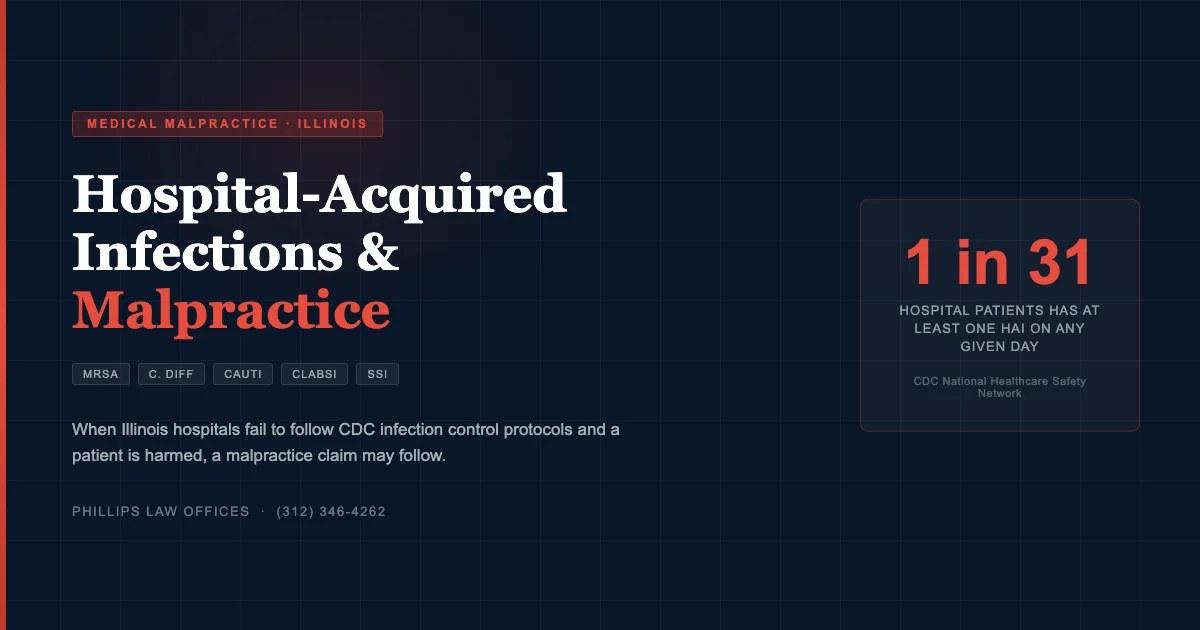
Short answer: Hospital-acquired infections (HAIs) such as MRSA, C. difficile, CAUTI, CLABSI, and surgical site infections can form the basis of an Illinois medical malpractice claim when a provider’s failure to follow established infection control protocols directly caused measurable patient harm. Proving these cases requires demonstrating a breach of the standard of care, typically measured against CDC and NHSN guidelines, and that the breach caused a distinct injury beyond the patient’s underlying condition. Illinois law gives injured patients two years from discovery to file, and a 735 ILCS 5/2-622 affidavit of merit is required at the outset.
In my experience handling Illinois medical malpractice cases, hospital-acquired infection claims are among the most technically demanding. The science is not intuitive to jurors: a patient enters the hospital already sick, develops a serious secondary infection, and the hospital insists the infection was inevitable given the patient’s condition. Unraveling that argument requires two separate experts and a working command of infection control protocols most lawyers never encounter. When these cases are built correctly, they are among the most powerful malpractice claims available because the underlying negligence, such as a nurse skipping hand hygiene or a physician failing to remove a catheter on schedule, is often documented in the hospital’s own records.
What Is a Hospital-Acquired Infection?
A hospital-acquired infection, also called a healthcare-associated infection or nosocomial infection, is an infection a patient contracts during the course of receiving healthcare that was not present or incubating at the time of admission. The CDC defines the window as an infection occurring more than 48 hours after admission, more than three days after discharge, or within 30 days of an operative procedure.
The most common HAIs encountered in Illinois malpractice litigation include:
- MRSA (Methicillin-resistant Staphylococcus aureus): A drug-resistant staph infection that spreads through direct contact. Failure to implement contact precautions when a patient is known to be colonized is a classic breach.
- Clostridioides difficile (C. diff): A toxin-producing bacterium that causes severe colitis, often triggered by unnecessary or prolonged antibiotic use.
- CAUTI (Catheter-Associated Urinary Tract Infection): An infection arising from an indwelling urinary catheter that was either inserted without proper indication or left in place beyond clinical necessity.
- CLABSI (Central Line-Associated Bloodstream Infection): A bloodstream infection traced to a central venous catheter, often caused by failure to follow sterile insertion technique or maintenance protocols.
- VAP (Ventilator-Associated Pneumonia): Pneumonia developing in a mechanically ventilated patient, frequently linked to failure to elevate the head of the bed, inadequate oral care, or prolonged ventilation without reassessment.
- SSI (Surgical Site Infection): An infection at the site of an operative incision, linked to improper skin preparation, delayed antibiotic prophylaxis, or contaminated instruments.
The CDC’s National Healthcare Safety Network (NHSN) publishes detailed surveillance protocols and prevention guidelines for each infection type. These documents define the standard of care against which hospital conduct is measured.
The Standard of Care in Illinois HAI Cases
Illinois medical malpractice law requires a plaintiff to show that the defendant deviated from the standard of care, meaning the level of care a reasonably careful physician or healthcare facility would provide under the same or similar circumstances. In HAI cases, this standard is typically established through reference to published protocols:
- CDC/NHSN Prevention Guidelines: The NHSN publishes HAI prevention checklists and bundles that define minimum acceptable practices. Deviations from these guidelines are the primary basis for a standard-of-care opinion from an infection control expert.
- Hand hygiene compliance rates: Hospitals are required to monitor and document hand hygiene compliance. Internal audit data showing poor compliance rates are strong circumstantial evidence of systemic failure.
- Catheter care bundles: For CAUTI and CLABSI, the standard of care requires implementation of insertion and maintenance bundles. A hospital that cannot produce bundle compliance records is in a difficult position.
- Antibiotic stewardship: For C. diff and SSI, inappropriate antibiotic selection, dosing, or timing is a recognized breach. The Surgical Care Improvement Project (SCIP) sets specific timing requirements for prophylactic antibiotics in surgical patients.
- Contact precautions: For MRSA and similar pathogens, failure to isolate a known carrier and to use appropriate personal protective equipment breaches an established standard.
The Illinois Department of Public Health (IDPH) requires hospitals to report certain HAIs under 77 Ill. Admin. Code 527 (Hospital Licensing Requirements). These mandatory reports, obtained through discovery, often contain admissions about infection rates and may reveal that the hospital was already aware of an elevated incidence before the plaintiff’s infection.
Causation: The Hardest Element
Causation is where most HAI cases rise or fall. The defense will argue that the patient was critically ill, immunocompromised, or elderly, and that any infection the patient developed was an inevitable consequence of that condition, not the hospital’s fault. Illinois requires proof that the breach was a proximate cause of the harm.
To overcome the inevitability argument, plaintiff’s counsel must establish two distinct causation links:
- That the breach caused the infection. An infection control specialist testifies that, had the hospital followed proper protocols, the specific pathogen would not have colonized or infected this patient. This requires evidence that the breach created a route of transmission that proper technique would have prevented.
- That the infection caused a discrete additional harm. The plaintiff was already sick. The question is not whether the underlying condition harmed the patient, but whether the superimposed HAI caused a separately identifiable injury. Common examples: the HAI extended the ICU stay by 14 days during which the patient developed organ failure; the HAI required a second surgery that would not otherwise have been necessary; the HAI was the proximate cause of death in a patient whose underlying condition was not terminal.
This is why HAI cases require two separate causation experts. The infection control specialist addresses the breach and the mechanism of transmission. The infectious disease physician addresses what the HAI specifically did to this patient’s body and what would have happened in its absence.
“In every HAI malpractice case, I retain two separate causation experts from the beginning: an infection control specialist to establish the breach in prevention protocol, and an infectious disease physician to trace what the resulting infection specifically did to this patient beyond what their underlying condition would have caused. Without that separation, defense counsel collapses both issues into one argument and the jury never understands that two independent wrongs occurred.”
How Illinois Reporting Requirements Create the Paper Trail
One significant advantage in Illinois HAI cases is the mandatory reporting infrastructure. Under 77 Ill. Admin. Code 527.220, hospitals must report specified HAIs to the IDPH. These reports include data on infection rates by unit and procedure type. When the plaintiff’s infection occurred in a unit with a documented elevated infection rate, those reports create a powerful inference of systemic, ongoing negligence.
Beyond mandatory reports, discovery in HAI cases typically targets:
- Hand hygiene audit records by unit and shift
- CAUTI or CLABSI bundle compliance logs
- Antibiotic stewardship committee records
- Prior patient complaints or incident reports about similar infections
- Joint Commission survey reports
- Credentialing and training records for staff involved in the patient’s care
Illinois courts have held that hospital internal reports generated in the ordinary course of business, as distinct from peer review documents, are discoverable. Defense counsel routinely asserts the medical studies privilege under 735 ILCS 5/8-2101 to shield internal quality reviews. Correctly categorizing which documents are peer review protected versus which are ordinary business records is one of the first strategic battles in any HAI case.
Common HAIs, Prevention Standards, and How Breach Is Demonstrated
| Infection Type | Key Prevention Standard | Common Breach Evidence |
|---|---|---|
| MRSA | Contact precautions for known carriers; hand hygiene before/after patient contact | No gown/glove orders in chart; hand hygiene audit failures; roommate with documented MRSA colonization |
| C. diff (CDI) | Antibiotic stewardship; contact precautions; soap-and-water hand hygiene | Broad-spectrum antibiotics without documented indication; no contact precautions after positive test |
| CAUTI | Catheter insertion bundle; daily necessity review; early removal | Catheter left in place without documented clinical justification after day 2; insertion checklist missing |
| CLABSI | Sterile insertion technique; maximal barrier precautions; daily line necessity review | Missing insertion checklist; no cap/gown/drape documentation; line not removed on reassessment |
| VAP | Head-of-bed elevation 30-45 degrees; oral decontamination; daily sedation vacation and extubation readiness | Nursing notes showing HOB flat; no oral care documentation; prolonged ventilation without readiness assessment |
| SSI | Appropriate prophylactic antibiotic within 60 minutes of incision; skin prep with chlorhexidine-alcohol; normothermia | Antibiotic given after incision; betadine-only prep when protocol required chlorhexidine; prolonged OR time without re-dosing |
Illinois Procedural Requirements
Illinois imposes two critical procedural requirements on any medical malpractice plaintiff, including those pursuing HAI claims.
Affidavit of Merit (735 ILCS 5/2-622): Before or within 90 days of filing suit, the plaintiff must attach a written report from a qualified healthcare professional attesting that there is a reasonable and meritorious cause for filing the action. In HAI cases, this report must address both the standard of care breach and causation. Filing without the affidavit results in dismissal. This requirement means counsel must retain and consult with at least one expert, typically the infection control specialist, before the complaint is filed.
Statute of Limitations (735 ILCS 5/13-212): The limitations period for medical malpractice in Illinois is two years from the date the plaintiff knew or should have known of the injury and its likely negligent cause. For HAI cases, this clock often starts not when the infection is diagnosed, but when the patient (or their family) first has reason to connect the infection to a specific act or omission by the hospital. Minors have until age 8 or two years from the date of the act, whichever is later, with an absolute 4-year repose period for adults under 735 ILCS 5/13-212(a).
Can I sue a hospital for MRSA I developed after surgery in Illinois?
Yes, if the hospital’s failure to follow contact precautions, hand hygiene protocols, or sterile technique caused your MRSA infection and the infection caused you measurable harm beyond your underlying condition. You need an infection control expert to opine on the breach and an infectious disease specialist to address causation. The two-year statute of limitations runs from when you knew or should have known the infection was likely caused by hospital negligence, not necessarily from the date of your surgery.
What if the hospital says the infection was an unavoidable complication?
The defense uses this argument routinely, but it is not a complete defense under Illinois law. An unavoidable complication is one that can occur despite proper care. If the hospital cannot demonstrate it followed its own infection control protocols, the “unavoidable complication” argument fails. Discovery into hand hygiene audits, catheter bundle compliance, and antibiotic stewardship records often reveals that the protocols were not followed, converting a claimed “unavoidable complication” into a documented breach.
How do I get the hospital’s infection rate records?
Illinois hospitals are required to report HAI data to the IDPH under 77 Ill. Admin. Code 527. These reports are obtainable through a FOIA request to the IDPH. In litigation, you can also obtain the hospital’s internal infection surveillance data through discovery. The key is to distinguish ordinary business records (discoverable) from peer review committee records (protected under 735 ILCS 5/8-2101), which requires careful review of how the documents were generated and used.
What damages can I recover in an Illinois HAI malpractice case?
Recoverable damages include medical expenses caused by the HAI (additional hospitalization, surgeries, rehabilitation), lost wages during extended recovery, pain and suffering attributable to the infection beyond the underlying condition, disfigurement from surgical debridement or wound management, and in cases involving death, wrongful death damages under the Illinois Wrongful Death Act (740 ILCS 180/). Illinois does not cap compensatory damages in medical malpractice cases following the Illinois Supreme Court’s ruling in Lebron v. Gottlieb Memorial Hospital (2010).
How long does an Illinois HAI malpractice case take?
HAI cases are complex and typically take 2 to 4 years from filing to resolution, depending on whether the case settles or goes to trial. The expert-intensive nature of these cases means significant time is spent on expert depositions, Daubert-style challenges, and pre-trial motions. Cases involving death or catastrophic injury are more likely to proceed to trial because settlement values are higher and defense insurers resist early resolution.
Authoritative Sources
- 735 ILCS 5/2-622, Affidavit of Merit Requirement (Illinois General Assembly)
- 735 ILCS 5/13-212, Medical Malpractice Statute of Limitations (Illinois General Assembly)
- 77 Ill. Admin. Code 527, Hospital Licensing Requirements / HAI Reporting (IDPH)
- 735 ILCS 5/8-2101, Medical Studies Privilege (Illinois General Assembly)
- CDC National Healthcare Safety Network (NHSN), HAI Surveillance and Prevention Protocols
Related Illinois Injury Guides
- Surgical Never Events and Malpractice in Illinois
- Emergency Room Errors and Medical Malpractice in Illinois
- Medication Errors and Malpractice Claims in Illinois
- Anesthesia Errors and Medical Malpractice in Illinois
If you or a family member developed a serious infection during a hospital stay in Illinois, contact Phillips Law Offices at (312) 346-4262 for a free consultation.
This guide is part of our Chicago Medical Malpractice Claims section, where you can find every related guide on this site.