
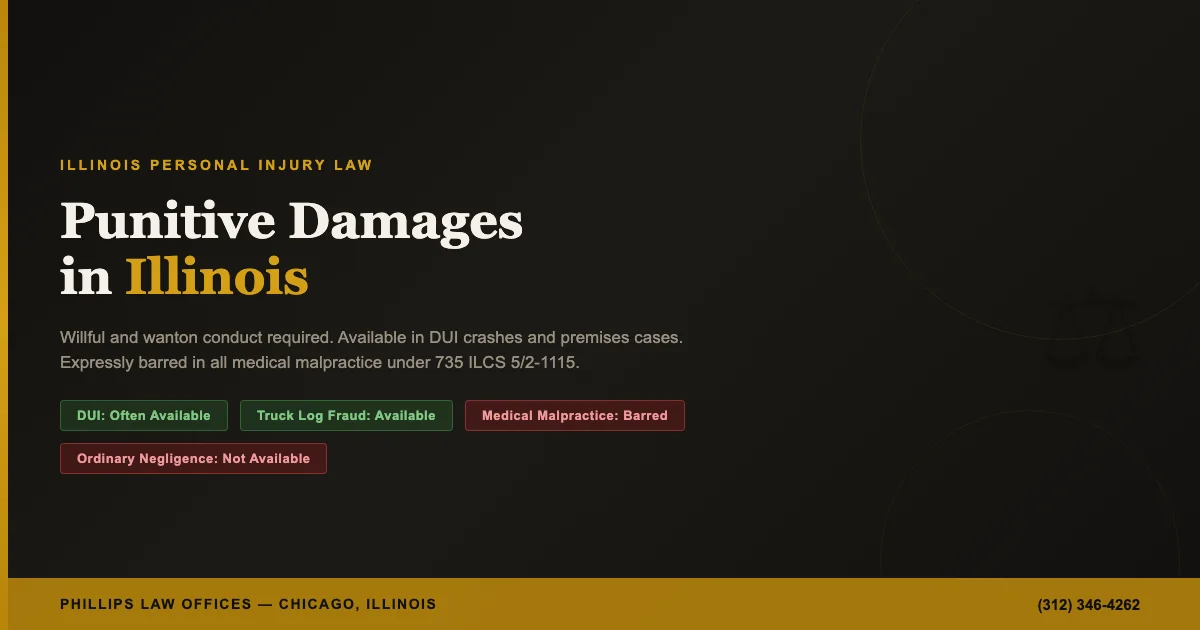
Short answer: Punitive damages in Illinois require proof of willful and wanton conduct, meaning conduct that shows a conscious disregard for the rights and safety of others. They are available in certain car accident and premises liability cases but are expressly prohibited in all medical malpractice cases under 735 ILCS 5/2-1115. The threshold is deliberately high: ordinary negligence, even serious negligence, does not support a punitive claim. A defendant who was drunk, falsified safety records, or concealed a known hazard may meet the standard; a defendant who was simply careless generally does not.
In my experience handling Illinois personal injury cases, punitive damages are both the most misunderstood remedy available to injured plaintiffs and the one that requires the most precise pleading strategy. Clients often arrive after a serious accident asking whether the at-fault party can be “punished.” The honest answer is that punishment is available in Illinois courts, but only when the evidence supports something beyond carelessness. Getting the pleading right from day one matters enormously, because attempting to add punitive damages after discovery closes is significantly harder than including them in the original complaint when the facts support it.
The Illinois Standard: Willful and Wanton Conduct
The foundational case for punitive damages in Illinois is Kelsay v. Motorola, 74 Ill.2d 172 (1978), in which the Illinois Supreme Court confirmed that punitive damages are available in cases involving willful and wanton conduct. Illinois courts define willful and wanton conduct as conduct performed with actual intent to harm, or conduct showing a deliberate disregard for or conscious indifference to the safety or rights of others.
The distinction between ordinary negligence and willful and wanton conduct is not always obvious in a fact pattern, but courts look for evidence that the defendant knew of a risk and proceeded anyway, rather than simply failing to perceive the risk. A driver who fails to see a stop sign and runs it is negligent. A driver who sees the stop sign, is traveling at 85 mph in a 35 mph zone with a blood alcohol content of 0.18, and runs it while weaving through traffic may be willful and wanton.
Illinois courts do not require a showing of subjective intent to harm. The standard is objective: would a reasonable person in the defendant’s position have recognized that the conduct created a high degree of probability of serious harm, and did the defendant proceed anyway?
The Absolute Bar: Medical Malpractice Cases
The most important limitation on punitive damages in Illinois is the statutory bar in medical malpractice cases. 735 ILCS 5/2-1115 provides that in any action for damages resulting from medical, dental, optometric, or related health professional services, punitive damages are not recoverable. This is not a procedural hurdle, it is a complete substantive bar. No matter how egregious the conduct of the health care provider, punitive damages are simply unavailable as a matter of Illinois law.
This bar has teeth. Illinois courts have applied it strictly. A surgeon who repeatedly performed unnecessary procedures for financial gain, a hospital that concealed a pattern of infections from patients, a nursing home that knowingly understaffed to cut costs: none of these defendants can face a punitive damages claim in Illinois. The injured plaintiff is limited to compensatory damages, including economic losses and non-economic damages such as pain and suffering.
For clients who are angered by egregious healthcare conduct, the honest advice is this: the legislature made a policy choice in 735 ILCS 5/2-1115, and Illinois courts have declined to override it. The focus in malpractice cases must be on maximizing compensatory recovery.
Bifurcated Trial Process Under Illinois Law
Under 735 ILCS 5/2-1115.05, a defendant in an Illinois case where punitive damages are sought may request that the trial be bifurcated: liability is decided in the first phase, and if liability is found, the punitive damages question is tried separately in the second phase. This procedural structure matters for litigation strategy. Plaintiffs must be prepared to present punitive damages evidence in a separate trial segment, and defendants use the bifurcation option to prevent the jury from hearing inflammatory punitive damages evidence during the liability phase.
The practical implication is that plaintiffs’ counsel must build two parallel cases in discovery: the liability case and the punitive damages case. Documents showing corporate knowledge of a risk, training records that were ignored, or internal communications describing cost-benefit analyses about safety features are all relevant to the punitive phase and must be preserved and developed during pre-trial discovery.
When Punitive Damages Apply in Illinois: Common Scenarios
Courts have found willful and wanton conduct in a range of fact patterns. The following are scenarios where punitive damages are regularly pursued in Illinois personal injury cases.
Drunk driving with extreme intoxication. A DUI alone may not always reach the willful and wanton threshold. Illinois courts look at the degree of intoxication and the circumstances. A driver with a BAC of 0.16 or higher (twice the legal limit) who drove on a highway at excessive speed is more likely to meet the standard than a driver barely over the 0.08 limit involved in a minor collision. The more extreme the circumstances, the stronger the punitive claim.
Commercial truck driver falsifying logs. Federal Motor Carrier Safety Administration hours-of-service regulations exist to prevent fatigued driving. A truck driver who deliberately falsifies log books to conceal that they have been driving far beyond legal limits, and then causes a crash, has engaged in a willful violation of federal safety rules. Courts treating FMCSA log falsification as willful and wanton conduct is well-established in Illinois commercial truck litigation.
Employer who concealed a known safety hazard. When an employer discovers that a machine, product, or worksite condition creates a serious risk of injury, documents that risk in internal communications, and then does nothing to fix it to avoid the expense, the concealment and conscious choice to leave the hazard in place can support a punitive claim.
Road rage assault. A driver who intentionally uses their vehicle as a weapon during a road rage incident has committed an intentional tort. Punitive damages are clearly available, the conduct is not merely negligent but deliberately harmful.
Punitive Damages Scenarios: Illinois Quick Reference
| Scenario | Punitive Damages Available? | Key Factor |
|---|---|---|
| Drunk driver, BAC 0.16+, highway crash | Often yes | Extreme intoxication shows conscious disregard |
| Drunk driver, BAC 0.09, minor fender-bender | Unlikely | Borderline intoxication, low danger level |
| Truck driver falsifying FMCSA logs | Yes (strong claim) | Willful federal safety violation |
| Ordinary driver running a red light | No | Negligence only, no conscious disregard |
| Employer concealing known safety defect | Yes (with documentation) | Corporate knowledge + deliberate inaction |
| Road rage intentional assault | Yes | Intentional conduct, not mere negligence |
| Medical malpractice (any type) | Never, statutory bar | 735 ILCS 5/2-1115 absolute prohibition |
| Slip-and-fall, ordinary wet floor | No | Negligence only |
| Property owner ignoring repeated safety complaints | Possibly | Documented prior notice + conscious indifference |
What is the legal standard for punitive damages in Illinois?
Illinois requires proof of willful and wanton conduct, established in Kelsay v. Motorola, 74 Ill.2d 172 (1978). This means the defendant either acted with actual intent to harm, or acted with a conscious disregard for the high probability that their conduct would cause serious injury. Ordinary negligence, failing to act as a reasonable person, does not meet the standard. The plaintiff must present evidence that the defendant knew of the risk and proceeded with deliberate indifference.
Are punitive damages available in Illinois medical malpractice cases?
No. 735 ILCS 5/2-1115 expressly bars punitive damages in all medical malpractice actions in Illinois. This is a complete statutory prohibition that courts have applied strictly. No matter how egregious the healthcare provider’s conduct, punitive damages are not available in a malpractice case. The remedy for even the most serious medical negligence is limited to full compensatory damages.
Can the defendant request a separate trial on punitive damages?
Yes. Under 735 ILCS 5/2-1115.05, a defendant may request that the court bifurcate the trial: the jury first decides liability and compensatory damages, then, if liability is established, a separate proceeding addresses punitive damages. Defendants routinely exercise this option to keep punitive damages evidence away from the jury during the liability phase. Plaintiffs must be prepared for a two-phase trial in cases where punitive damages are claimed.
Does Illinois cap the amount of punitive damages a jury can award?
Illinois does not impose a statutory cap on punitive damages in personal injury cases, unlike some other states. However, courts apply constitutional proportionality review under the U.S. Supreme Court’s guidance in BMW of North America v. Gore, 517 U.S. 559 (1996) and State Farm Mutual Automobile Insurance Co. v. Campbell, 538 U.S. 408 (2003). Illinois courts consider the ratio of punitive to compensatory damages, with ratios above 9:1 facing heightened constitutional scrutiny. The most defensible punitive awards are those where the ratio is reasonable given the nature and degree of the defendant’s misconduct.
Why does it matter whether I plead punitive damages in the original complaint?
Pleading willful and wanton conduct from the start of the case signals to the defendant and the insurance carrier that this is not a routine negligence claim, which affects settlement posture. More importantly, it opens discovery to internal documents, training records, safety audits, prior complaints, corporate communications, that are directly relevant to the punitive damages claim and would otherwise be difficult to justify requesting. Attempting to add punitive damages later in the case requires court approval and may be denied if discovery is nearly complete. When the facts support it, the pleading decision should be made at the outset.
Authoritative Sources
- 735 ILCS 5/2-1115, Bar on Punitive Damages in Medical Malpractice (ILGA)
- 735 ILCS 5/2-1115.05, Bifurcated Trial for Punitive Damages (ILGA)
- Kelsay v. Motorola, Inc., 74 Ill.2d 172 (1978), Illinois Supreme Court establishing punitive damages standard
- BMW of North America, Inc. v. Gore, 517 U.S. 559 (1996), U.S. Supreme Court proportionality review
- State Farm Mutual Automobile Insurance Co. v. Campbell, 538 U.S. 408 (2003), Constitutional limits on punitive awards
Related Illinois Injury Guides
- Illinois Personal Injury Case Timeline: What to Expect
- How Illinois Courts Calculate Pain and Suffering Damages
- Illinois DUI Accident Injury Claims
- Wrongful Death Damages and Distribution in Illinois
If you were seriously injured by someone whose conduct went beyond ordinary negligence in Illinois, call Phillips Law Offices at (312) 346-4262 for a free consultation. We evaluate whether the facts of your case support a punitive damages claim and build the evidence necessary to pursue it.
This guide is part of our Hiring a Chicago Injury Lawyer section, where you can find every related guide on this site.
For how claims are valued, negotiated and paid out, see our guide to settlements and compensation.