 Written by
 Short answer: Spinal cord injuries are among the most costly and permanently disabling outcomes of Illinois accidents. Complete SCIs result in total loss of motor and sensory function below the injury level; incomplete SCIs preserve some function. Lifetime care costs for high cervical injuries exceed $1 million in the first year alone. Illinois law allows full recovery of past and future medical expenses, lost earnings, and pain and suffering with no cap on compensatory damages. A life care plan prepared by a qualified expert is the essential document for proving future damages, without it, courts frequently exclude those projections as speculative.
In my experience handling Illinois personal injury cases, spinal cord injury cases require a level of expert preparation that goes well beyond a typical car accident or slip and fall claim. The liability questions are often straightforward. The challenge is building a damages case that accurately projects 30, 40, or 50 years of future medical care, assistive equipment, home modifications, and attendant care, and doing it with enough evidentiary foundation that it survives a defense motion to exclude the life care planner’s opinions. Getting that process right from the beginning of the case determines whether a seriously injured client receives compensation that actually covers their life, or walks away with a fraction of what they need.
SCI Classification, Complete vs. Incomplete and the ASIA Scale
The medical classification of a spinal cord injury determines the range of functional loss, the expected course of rehabilitation, and ultimately the scope of future damages. Medical experts use the American Spinal Injury Association (ASIA) Impairment Scale to classify SCI severity:
- ASIA A, Complete: No motor or sensory function is preserved in the sacral segments S4-S5. Total loss below the injury level.
- ASIA B, Sensory Incomplete: Sensory but not motor function is preserved below the neurological level and includes the sacral segments.
- ASIA C, Motor Incomplete: Motor function is preserved below the neurological level; more than half of key muscle groups below the injury level have a muscle grade less than 3.
- ASIA D, Motor Incomplete: Motor function is preserved below the neurological level; at least half of key muscle groups have a muscle grade of 3 or more (active movement against gravity).
- ASIA E, Normal: Motor and sensory function are normal. (An ASIA E classification following SCI may still involve pain, autonomic dysfunction, or other sequelae.)
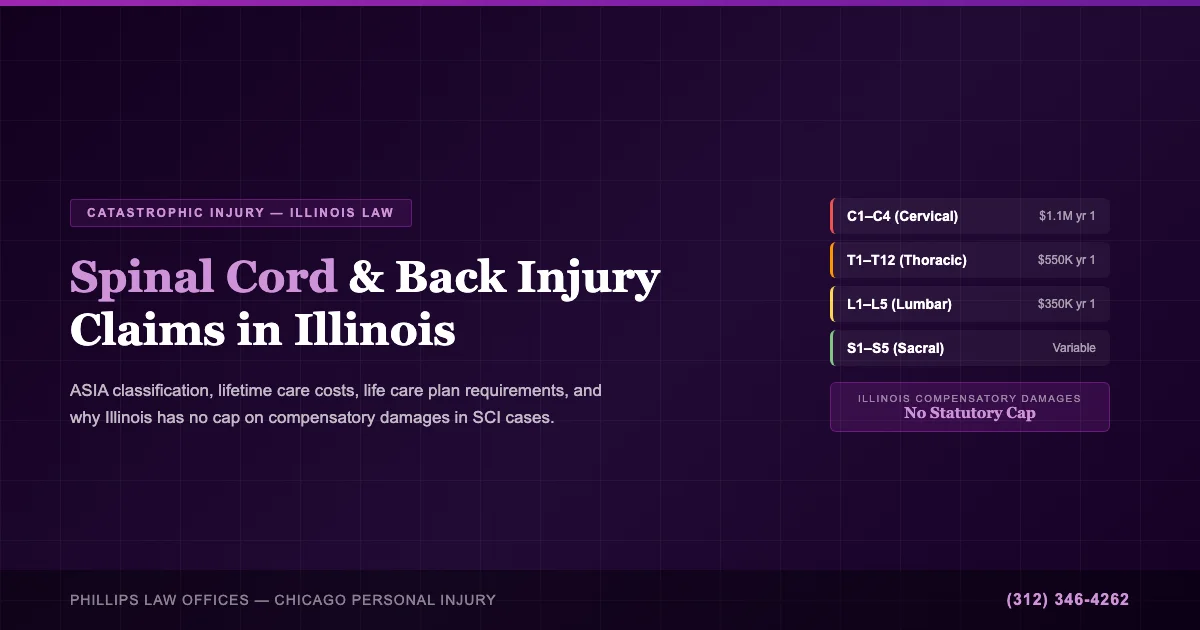
The injury level, the lowest spinal segment with normal function, determines the character and extent of functional loss. Cervical injuries (C1-C8) affect all four limbs and respiratory function. Thoracic injuries (T1-T12) affect trunk stability and lower limb function, resulting in paraplegia. Lumbar injuries (L1-L5) affect lower limb movement and some bladder function. Sacral injuries (S1-S5) affect bladder, bowel, and sexual function with variable lower limb involvement.
SCI Levels, Functional Impact, and Approximate Lifetime Care Cost Ranges
| Injury Level | Classification | Typical Functional Impact | First-Year Care Cost (Approx.) | Annual Subsequent Cost (Approx.) |
|---|---|---|---|---|
| C1–C4 (High Cervical) | Complete (ASIA A) | Quadriplegia; ventilator dependence possible; no hand, arm, trunk, or leg function | $1,100,000+ | $200,000+ |
| C5–C8 (Low Cervical) | Complete (ASIA A) | Quadriplegia; some arm/hand function preserved; independent breathing typically preserved | $800,000+ | $115,000+ |
| T1–T12 (Thoracic) | Complete (ASIA A) | Paraplegia; full arm/hand function; trunk stability varies by level | $550,000+ | $75,000+ |
| L1–L5 (Lumbar) | Complete or Incomplete | Variable lower limb function; some ambulatory potential with assistive devices | $350,000+ | $45,000+ |
| Any level | Incomplete Motor (ASIA C/D) | Partial preservation of motor and sensory function; broad functional range depending on level and completeness | $350,000+ | $45,000+ |
Cost figures based on National Spinal Cord Injury Statistical Center data. Actual costs vary significantly based on injury completeness, age at injury, complications, and geographic location of care.
The life care plan is the single most important document in a spinal cord injury case, and the one defense attorneys fight hardest to exclude. Without it, a client’s future medical needs, attendant care requirements, equipment costs, and home modification expenses are speculative opinions that a court may refuse to let the jury hear. With a well-prepared life care plan supported by treating physicians and costed by a rehabilitation economist, the future damages are concrete projections based on this individual’s specific injury, age, and functional status. Every dollar not supported by the life care plan is a dollar the defense argues the jury should ignore. Building that plan correctly, early, with the right experts, is the difference between adequate compensation and a settlement that runs out in five years.
Chicago Rehabilitation Resources and the Cost of Inpatient SCI Rehab
Where an SCI patient receives initial rehabilitation care has a direct bearing on both their functional outcome and the documented cost base for future damages. The Shirley Ryan AbilityLab (formerly the Rehabilitation Institute of Chicago), located in Chicago’s Streeterville neighborhood, is consistently ranked the number one rehabilitation hospital in the United States. It specializes in spinal cord injury, traumatic brain injury, and stroke rehabilitation. Inpatient SCI rehabilitation costs at facilities of this caliber frequently exceed $1,000 per day, with comprehensive SCI rehab admissions routinely lasting 30 to 90 days or longer depending on injury level and functional gains.
The cost of rehabilitation is a recoverable element of damages in an Illinois personal injury case. When an at-fault party’s negligence caused the injury, they are responsible for the reasonable cost of treatment at the level of care the injury requires, not the cheapest facility available. A plaintiff should not be required to accept inferior care because the defendant prefers a lower damages number.
Cervical and Lumbar Disc Herniations, SCI-Adjacent Injuries in Crash Cases
Many rear-end and high-impact crash cases produce cervical disc herniation (herniated disc in the neck) or lumbar disc herniation (herniated disc in the lower back) without complete or incomplete SCI. These injuries are clinically distinct from SCI, the spinal cord itself is not severed or contused, but they share important characteristics:
- MRI findings are the primary evidence of the injury. Insurance defense attorneys routinely challenge soft-tissue cervical and lumbar claims when MRI imaging is not obtained, arguing the injury is not objectively documented.
- Defense medical examiners frequently characterize disc herniations as “pre-existing degenerative disc disease”, arguing that the crash merely accelerated or aggravated a condition that was already present and would have caused symptoms regardless of the accident. The Illinois eggshell plaintiff rule addresses this: a defendant takes the plaintiff as they find them, and a pre-existing condition that was asymptomatic does not bar recovery for the symptomatic condition the crash caused.
- Surgical cases (anterior cervical discectomy and fusion, lumbar microdiscectomy, lumbar fusion) carry substantially higher damages than conservative care cases. Surgical necessity, documented by the treating surgeon and supported by imaging, is critical to supporting the claimed damages.
Multiple Defendants in SCI Cases
Serious spinal cord injury cases often involve more than one at-fault party. Identifying all responsible defendants is important both for ensuring adequate insurance coverage and for distributing fault appropriately under Illinois law.
At-fault driver: The primary defendant in crash cases. Their personal auto liability policy and any umbrella coverage are the first source of recovery.
Employer / commercial vehicle operator: If the at-fault driver was operating a commercial vehicle in the course of their employment, the employer is vicariously liable under respondeat superior. Commercial vehicle policies carry substantially higher limits than personal auto policies, often $1 million or more, which matters enormously in SCI cases with multi-million dollar damages projections.
Vehicle manufacturer: If a safety system failure contributed to the severity of the injury, a seatbelt that failed to restrain, an airbag that deployed incorrectly or not at all, or a seat that collapsed, the manufacturer may be liable under Illinois strict product liability. These claims require early retention of a biomechanical engineer and accident reconstructionist to examine the vehicle before it is repaired or destroyed.
Road or property owner: In cases involving a road defect, missing guardrail, or hazardous condition on a property, IDOT, IDNR, or a private property owner may share liability. Government entity defendants trigger the notice and limitations provisions under the Illinois Tort Immunity Act.
Under Illinois joint and several liability rules modified by 735 ILCS 5/2-1117, defendants who are more than 25% at fault are jointly and severally liable for all economic damages. Defendants found 25% or less at fault are liable only for their proportionate share. This framework makes the allocation of fault among multiple defendants a strategic issue in SCI litigation.
Illinois Law on Damages, No Cap on Compensatory Awards
Illinois does not cap compensatory damages in personal injury cases. The Illinois Supreme Court struck down a legislatively enacted cap on non-economic damages in Lebron v. Gottlieb Memorial Hospital (2010) and earlier decisions. The full range of economic and non-economic damages is available to a plaintiff who can prove them:
- Past medical expenses: All documented treatment costs from the date of injury to the date of trial.
- Future medical expenses: Life care plan projections for all anticipated future treatment, equipment, home modification, and attendant care, discounted to present value by a rehabilitation economist.
- Lost past wages: Income lost from the date of injury to the date of trial, documented by employment records and tax returns.
- Lost future earning capacity: The present value of the difference between what the plaintiff would have earned absent the injury and what they can earn (if anything) given their current functional limitations, typically established by a vocational rehabilitation expert and an economist.
- Pain and suffering: Non-economic damages for physical pain, emotional distress, and the subjective experience of living with permanent disability. No formula exists, the jury assesses this amount based on the evidence.
- Loss of normal life: A recognized category of non-economic damages in Illinois for the loss of the ability to engage in activities and enjoy life as the plaintiff did before the injury.
Frequently Asked Questions
How long do I have to file a spinal cord injury claim in Illinois?
Two years from the date of the injury under 735 ILCS 5/13-202. If the injured person is a minor, the statute does not begin to run until they turn 18, but the practical effect is that evidence preservation becomes more difficult the longer litigation is delayed. For claims against governmental entities, shorter notice periods apply. For cases involving a commercial vehicle and potential product liability, retaining an attorney immediately to preserve the vehicle and accident scene evidence is critical.
What is a life care plan and who prepares it?
A life care plan is a comprehensive projection of all future medical, therapeutic, equipment, home modification, and attendant care needs for a person with a permanent injury or disability. It is prepared by a certified life care planner, typically a registered nurse or rehabilitation specialist with specialized credentialing, working in consultation with the treating physicians, physiatrists, and occupational therapists who know the patient’s specific condition. The plan is then submitted to a rehabilitation economist who discounts the projected costs to present value for purposes of a damages award. Courts frequently require that future damages be supported by a life care plan to avoid exclusion as speculative.
Can I recover damages if my spinal injury was made worse by a pre-existing condition?
Yes. Under the Illinois eggshell plaintiff doctrine, a defendant is liable for the full extent of harm caused to a plaintiff, even if the plaintiff was more susceptible to injury due to pre-existing conditions like degenerative disc disease, osteoporosis, or prior spinal surgery. If a crash caused a herniated disc at a level where the plaintiff already had degenerative changes, the defendant cannot use that pre-existing condition to escape liability for the symptomatic injury the crash produced. The defendant takes the plaintiff as they find them.
What if the SCI was caused partly by a vehicle safety system failure?
Product liability claims based on seatbelt, airbag, or structural failure run parallel to the negligence claim against the at-fault driver. Illinois follows strict liability in tort for product defects under the Restatement (Second) of Torts, Section 402A, as adopted by the Illinois Supreme Court in Greenman v. Yuba Power Products and its Illinois progeny. The vehicle must be preserved, do not allow the insurance company to total and dispose of the vehicle before a biomechanical engineer can inspect it. Loss of the vehicle before inspection can result in a spoliation sanction against the party who controlled it.
Is there a cap on damages for SCI claims in Illinois?
No. Illinois does not cap compensatory damages in personal injury cases. The Illinois Supreme Court has struck down legislative damage caps in personal injury actions as unconstitutional violations of the separation of powers. Full recovery of economic damages (medical expenses, lost earnings, life care plan costs) and non-economic damages (pain and suffering, loss of normal life, disability) is available without a statutory ceiling. Punitive damages are available in cases involving willful and wanton conduct, though they are less common in typical crash cases.
Authoritative Sources
- 735 ILCS 5/13-202, Personal Injury Statute of Limitations
- 735 ILCS 5/2-1116, Illinois Modified Comparative Fault
- 735 ILCS 5/2-1117, Illinois Joint and Several Liability
- 625 ILCS 5/7-203, Illinois Vehicle Code, Required Liability Insurance
- National Spinal Cord Injury Statistical Center, Facts and Figures
Related Illinois Injury Guides
- Illinois Minimum Auto Insurance and What It Means for Your Injury Claim
- Future Medical Expenses in Illinois Personal Injury Cases
- The Illinois Eggshell Plaintiff Rule
- Pain and Suffering Damages in Illinois
If you or a family member suffered a spinal cord or serious back injury in an Illinois accident, contact Phillips Law Offices at (312) 346-4262 for a free consultation. We work with life care planners, rehabilitation economists, and medical experts to build a complete future damages case for clients with catastrophic injuries.