

Speeding is one of the most common causes of serious car accidents in Chicago, and it’s rarely just a ticket-worthy nuisance. Whether it happens on the Kennedy Expressway, the curves near Lake Shore Drive, or a narrow neighborhood street in Logan Square, Pilsen, or Bronzeville, a driver going too fast for conditions loses the margin that makes most close calls survivable. If you or someone you love was hurt in a speeding crash, understanding how Illinois law treats these cases, and how insurers try to complicate them, matters from the first day.
This guide covers what Illinois’ speed laws actually require, how a speeding claim differs from an ordinary two-car accident, what evidence tends to prove excessive speed after the fact, and how comparative fault and filing deadlines apply once a claim moves forward.
Why Hiring a Lawyer Changes How a Speeding Claim Gets Handled
Speeding accidents often involve high-impact collisions, disputed fault, and insurance companies looking for any available reason to reduce a payout. A speeding accident lawyer’s role from day one is different from what a driver can accomplish negotiating alone, since much of the evidence that actually proves excessive speed, camera footage, black box data, witness accounts, has a limited shelf life and needs to be secured before it disappears. That work generally includes a full accident investigation, gathering black-box data and traffic camera footage, identifying every insurer that may owe coverage, calculating both current and long-term damages, and handling all communication with adjusters so nothing you say gets used to minimize your claim.
What Illinois Law Actually Says About Speed
Illinois’ basic speed statute, 625 ILCS 5/11-601, doesn’t just set numeric limits, it requires driving at a speed that’s reasonable and proper for the actual conditions, meaning a driver going the posted limit in heavy fog, black ice, or dense pedestrian traffic can still be negligent for driving too fast for conditions. This matters in Chicago specifically, since weather, construction zones, and unpredictable foot traffic change what “safe speed” means block to block.
Illinois also treats extreme speeding as more than a routine traffic violation. Under 625 ILCS 5/11-601.5, driving 26 miles per hour or more over the posted limit is classified as aggravated speeding, a criminal offense rather than an ordinary citation. A driver charged with aggravated speeding at the time of a crash gives an injury claim a meaningfully stronger negligence argument than an ordinary “a few miles over the limit” case, since the degree of the violation itself signals a higher level of recklessness.
Why Speed Changes the Physics of a Crash
A higher speed doesn’t just make a crash more likely, it makes the crash itself dramatically worse. Stopping distance increases sharply as speed rises, which is part of why speeding is such a common factor in expressway pileups on the Eisenhower and Dan Ryan. Reaction time works against a speeding driver too: on streets crowded with cyclists, buses, and pedestrians, the extra fraction of a second that speed takes away is often the exact fraction of a second that would have prevented the crash. And because kinetic energy increases with the square of speed, not in a straight line, a crash at 50 miles per hour isn’t twice as severe as one at 25, it can be several times worse. Sharp curves, like the stretch along Lower Wacker Drive, and icy winter roads compound the risk further, since speed reduces a driver’s margin for correcting even a small mistake.
Common Injuries in Chicago Speeding Accidents
Because speeding crashes tend to involve higher-energy impacts, the injuries are frequently more severe than in a typical low-speed collision:
- Traumatic brain injuries
- Spinal cord injuries
- Fractures and crushed bones
- Internal bleeding or organ damage
- Whiplash and neck injuries
- Facial trauma and lacerations
- Burn injuries in crashes involving fire or fuel leakage
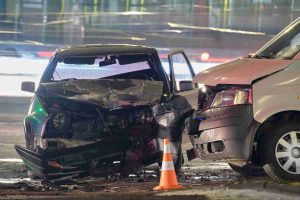
A broader overview of injury patterns across different crash types is available in our guide on common car accident injuries in Chicago.
How Comparative Negligence Applies to a Speeding Claim
Illinois follows a modified comparative negligence rule under 735 ILCS 5/2-1116. You can still recover damages even if you bear some responsibility for the crash, as long as your share of fault is 50% or less, though your recovery is reduced by your own percentage of fault. Insurers routinely try to shift some fault onto the injured party in speeding cases, arguing you could have reacted faster or left more following distance, even when the other driver’s excessive speed is the obvious primary cause. A worked example helps illustrate this: if a jury values a claim at $250,000 and finds you 10% at fault, your recovery drops to $225,000; if your fault were found to reach 51%, Illinois law bars recovery entirely.
A Hypothetical Illustration
Consider a hypothetical, not an actual case: a driver traveling 40 miles per hour in a 25 mph zone in Wicker Park fails to stop in time when traffic ahead brakes suddenly for a pedestrian, causing a multi-car chain-reaction crash. Black box data from the speeding vehicle confirms the excessive speed at impact, and a witness’s dashcam captures the moment traffic began braking. Between the two forms of evidence, insurers have very little room to argue the crash was unavoidable or that another driver contributed meaningfully to the outcome.
Street Racing and Illegal Speed Contests
Some of the most severe speeding crashes in Chicago come from organized or impromptu street racing rather than a single driver simply running late. Illinois specifically prohibits drag racing and speed contests on public roads under 625 ILCS 5/11-506, and a crash connected to an illegal speed contest can expose more than one driver to liability, since participants can sometimes be held jointly responsible for injuries caused during the race even if their own vehicle wasn’t the one that made contact. These cases also raise the punitive damages question discussed below more directly than an ordinary speeding claim, given how far removed racing is from an isolated lapse in judgment.
Rideshare and Commercial Vehicle Speeding
Speeding crashes involving an Uber, Lyft, or delivery driver add an extra layer of insurance coverage to sort through. Rideshare companies carry tiered commercial policies that activate depending on whether the driver had a passenger, had accepted a ride request, or was simply logged into the app waiting for one, and identifying which tier applies at the moment of the crash affects how much coverage is available. Commercial delivery and trucking companies carry their own separate policies as well, often with substantially higher limits than a personal auto policy, which is one more reason identifying every vehicle and driver involved in a speeding crash matters before any settlement discussion begins.
How to Prove the Other Driver Was Speeding
Speed itself often has to be reconstructed after the fact, since few crashes happen in front of a radar gun. An attorney may gather black box (EDR) data from the vehicle’s airbag control module, which records speed in the seconds before impact on most modern vehicles, along with traffic camera or nearby business surveillance footage, 911 call recordings, accident reconstruction analysis based on skid marks and damage patterns, and eyewitness statements. Roadway design records and posted speed limit history can matter too, particularly on streets where the limit changed recently or where sight lines are unusually short. Combining several of these sources tends to be far more persuasive to an insurer than relying on a single police report, since it’s harder to dispute multiple independent pieces of evidence that all point the same direction.
How Long You Have to File a Claim
Illinois gives injury victims two years from the date of the crash to file a personal injury lawsuit under 735 ILCS 5/13-202. That deadline shortens significantly if a government vehicle, like a CTA bus or a city-owned vehicle, was involved in the speeding crash: under 745 ILCS 10/8-101 of the Local Governmental and Governmental Employees Tort Immunity Act, the lawsuit against the public entity generally has to be filed within one year, a full year sooner than the ordinary deadline. Wrongful death claims arising from a fatal speeding crash carry their own separate timeline as well, so identifying every potential defendant early matters more than it might in a routine claim.
Why Evidence Preservation Has a Real Clock Running
Most of the strongest evidence in a speeding case has a shelf life measured in weeks, not years. Traffic camera and nearby business surveillance footage is frequently overwritten on a rolling basis, sometimes within 7 to 30 days depending on the system. Black box data can survive longer, but only if the vehicle isn’t repaired, resold, or scrapped in the meantime, since that process can overwrite or destroy the module. Witness memories fade quickly too, and a witness who’s easy to reach the week of the crash can be nearly impossible to locate six months later. A formal request to preserve evidence, sent to the other driver’s insurer, a nearby business, or a rideshare company, needs to go out early rather than waiting until a claim is fully developed.
Nighttime and Impaired Speeding
Speeding crashes that happen at night carry their own compounding risk factors. Reduced visibility already narrows a driver’s reaction window, and combining that with excessive speed and, in some cases, alcohol or drug impairment creates some of the most severe crashes seen on Chicago’s expressways and arterial streets. A driver who was both speeding and impaired faces a much steeper negligence case, since the combination undercuts nearly every defense an insurer might otherwise raise about unavoidable circumstances or split-second decisions. If impairment is suspected, toxicology results and the responding officer’s field observations become an important part of the evidentiary record alongside the speed data itself.
Compensation Available After a Speeding Accident
Economic damages typically include medical bills already incurred and reasonably projected into the future, lost wages, diminished earning capacity if the injury has lasting effects, and property damage. Non-economic damages cover pain and suffering, disability or disfigurement, emotional distress, and loss of enjoyment of life, none of which carry a fixed dollar value under Illinois law, though the severity and permanence of the injury heavily influence how they’re calculated. In fatal speeding crashes, surviving family members may recover funeral and burial costs, loss of financial support, and loss of companionship through a wrongful death claim, and a 2023 amendment to Illinois’ Wrongful Death Act now permits punitive damages in certain qualifying cases, a meaningful change from the prior law, which is worth discussing directly with an attorney if the speeding involved something more extreme than ordinary carelessness, like street racing or a documented pattern of reckless driving.
How Insurers Try to Minimize Speeding Claims
Insurance adjusters rarely deny outright that a driver was speeding when the evidence is strong. Instead, the more common tactic is arguing that the speed, while excessive, wasn’t the actual cause of the crash, or that the injured party contributed by braking late, failing to signal, or making some other split-second decision that a court might weigh against them. A quick early settlement offer is often designed to close the case before medical treatment is complete and before the full extent of a serious injury, like a herniated disc that gets worse with activity, has become clear. Our guide on compensation basics in Illinois car accident claims covers how to evaluate whether an offer actually reflects the full value of a claim before accepting anything.
Frequently Asked Questions
Does going the speed limit mean a driver can’t be found negligent?
No. Illinois’ basic speed law requires driving at a speed reasonable for the actual conditions, not just under the posted number. A driver going the limit in dangerous conditions can still be negligent for driving too fast for the circumstances.
What is aggravated speeding, and does it help my case?
Aggravated speeding under 625 ILCS 5/11-601.5 is driving 26 mph or more over the limit, treated as a criminal offense rather than an ordinary ticket. A criminal charge at this level can strengthen the negligence argument in a related civil claim.
How is speed proven if there’s no radar reading?
Black box data from the vehicle’s airbag control module, accident reconstruction based on skid marks and crush damage, and camera footage are the most common ways speed gets established after the fact.
What if I was also going a few miles over the limit?
Under Illinois’ modified comparative negligence rule, you can still recover damages as long as your share of fault doesn’t exceed 50%, though your recovery is reduced by your own percentage of fault.
Can black box data be deleted or lost before my case starts?
Yes, particularly if the vehicle is repaired or sent to salvage. A preservation request to the insurer or vehicle owner should go out as early as possible to make sure this data isn’t lost.
Was the other driver charged criminally for speeding? Does that affect my civil case?
A criminal citation or charge, especially for aggravated speeding, isn’t required for a civil injury claim, but it can serve as useful supporting evidence of negligence if one exists. The criminal case and the civil claim proceed on separate tracks with different standards of proof.
What if the speeding driver was working at the time of the crash?
If the driver was on the job, delivering for a company, driving a company vehicle, or working as a rideshare or commercial driver, their employer’s insurance policy may also be responsible under respondeat superior principles, in addition to the driver’s own coverage.
How long does a typical speeding accident claim take to resolve?
This varies significantly based on injury severity, how quickly liability evidence is gathered, and whether the case settles or requires a lawsuit. Cases with strong, well-preserved evidence often resolve faster than ones where key evidence had to be reconstructed after the fact.
Speak With a Chicago Speeding Accident Lawyer Today
If you or a loved one was injured in a speeding accident anywhere in Chicago, you don’t have to deal with the insurance companies on your own. Phillips Law Offices investigates the crash, gathers black box and camera evidence before it disappears, identifies every insurance policy that may apply, and pursues full compensation for your injuries. Consultations are free, and there’s no attorney fee unless the case results in a recovery.
Call (312) 346-4262 or visit our contact page to schedule your free consultation. Our guide on when to hire a Chicago car accident lawyer and our overview of Illinois car accident laws cover related ground if you’re still weighing your options. For crashes on expressways specifically, see our guide on highway crashes in Chicago. You can also start with our main Chicago car accident lawyer overview for a broader look at how these claims work from start to finish.